
There are massive changes taking place in the manufacturing sector. By 2026, global markets will demand faster production cycles, greater precision, and lower costs than ever before, which traditional systems cannot deliver. Companies relying on manual processes, disconnected systems, and reactive maintenance are struggling with rising material costs, unstable supply chains, and a workforce shortage.
Digital transformation in manufacturing helps organizations improve operational visibility, automate workflows, optimize production planning, and make data-driven decisions across the production cycle.
By integrating AI, cloud computing, and connected systems, smart factories enable real-time communication between machines, inventory, and business applications. These technologies help manufacturers increase productivity, reduce operational costs, and improve overall business performance.
What is Digital Transformation in Manufacturing?
Digital transformation in manufacturing refers to the implementation of new digital technology in all aspects of manufacturing companies. Digital transformation changes how operations are conducted in a factory and how value is delivered to customers.
This approach goes beyond merely upgrading a traditional machine to a new one. Rather, it involves networking all of the factory’s machines, sensors, data points, and personnel into a single, unified, transparent digital network.
Why Manufacturing Needs Digital Transformation in 2026
By 2026, the business environment will be highly competitive and less forgiving of slow operations. Customers demand personalization, quick delivery, and sustainable manufacturing.
Industries like consumer goods, the automotive sector, and heavy machinery can no longer rely on long production cycles. They must adapt their production schedules to keep pace with changing market demands.
At the same time, global supply chains are disrupted, material prices remain high, and skill shortages persist in the workplace. Digitalization in manufacturing cannot be delayed any longer. It has become a necessity.
Without real-time visibility into machine health, inventory levels, and energy consumption, manufacturers may experience lower efficiency, higher operating costs, and reduced competitiveness.
Key Technologies Driving Smart Factories
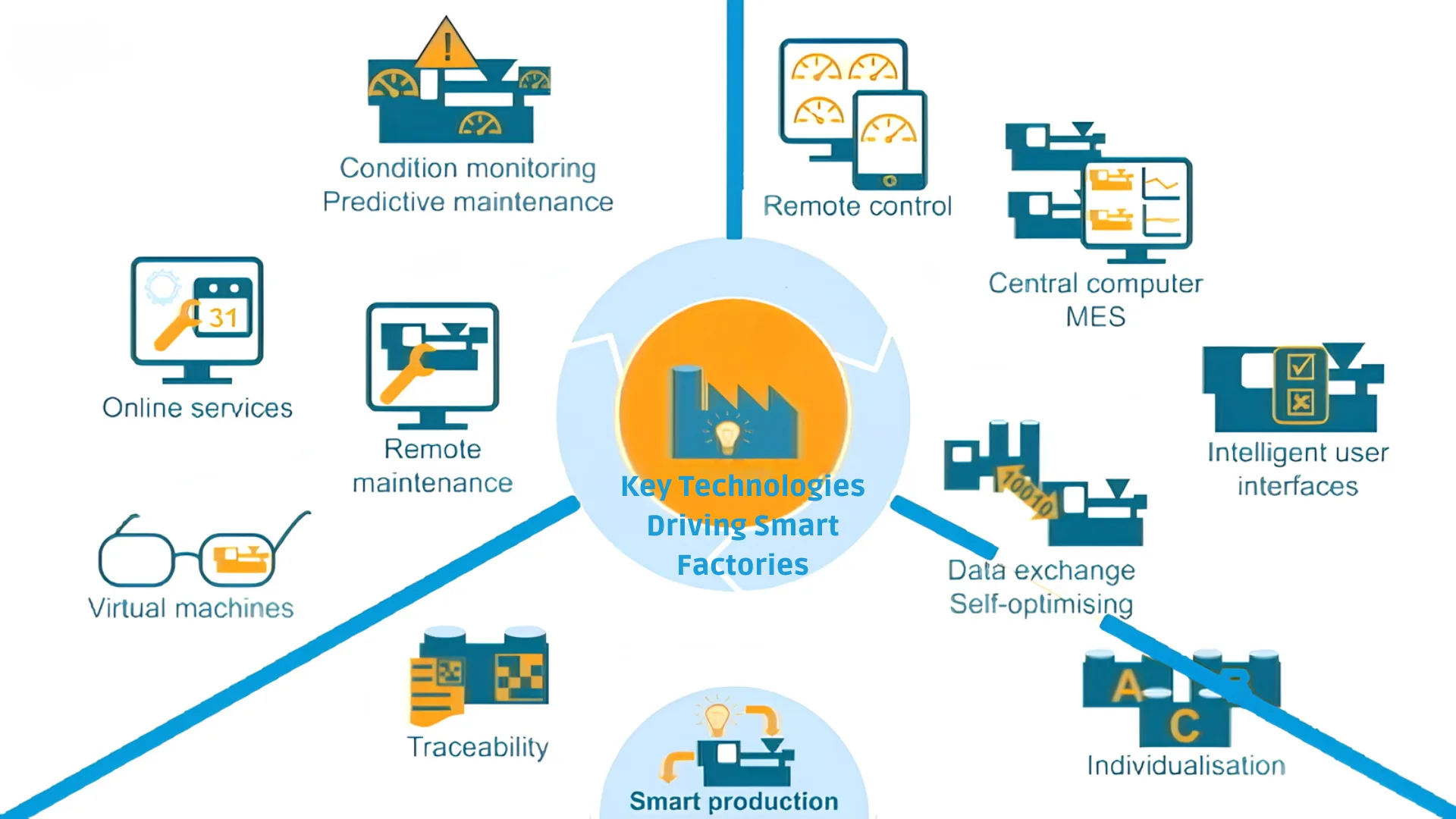
Smart factories depend upon a connected ecosystem of digital technologies that gather and act on production data:
- Cloud Computing: Works as a centralized platform to store and process industrial information, allowing the factory to handle large databases from various locations without investing in costly on-site servers. This system also facilitates worldwide access for management.
- Industrial Internet of Things (IIoT): Smart sensors placed on the equipment constantly monitor temperature, vibration, speed, and performance levels, which transmit real-time information to the cloud.
- Big Data Analytics: Analyzes large amounts of production data to reveal underlying patterns and areas for improvement.
- Digital Twins: Machines or production lines used in a virtual world for evaluating their performance without halting production operations in the physical world.
Role of AI in Manufacturing
Artificial Intelligence plays a central role in enabling smart manufacturing operations. Although sensors provide data and the cloud stores it, it is artificial intelligence that processes this data for decision-making, thereby minimizing human error.
Automated Quality Control is one of the many applications of AI through computer vision technology. High-speed cameras mounted on the conveyors scan all products as they pass, while AI detects minute imperfections, such as scratches and incorrect dimensions.
Machine learning algorithms are useful for production planning by analyzing orders, inventory, workforce availability, and machine efficiency. This results in optimized schedules that can be quickly adjusted if a machine malfunctions.
How Smart Factories Reduce Costs by 40%
The most important statistics to consider about 2026 are that smart factories reduce expenses due to increased efficiency by up to 40% in certain critical functions:
Predictive Maintenance Over Reactive Maintenance
Instead of repairing the machine when it breaks down or replacing its components at periodic intervals, AI-powered predictive maintenance solutions analyze sensor data such as vibration, temperature, pressure, and equipment performance to identify potential failures before they occur.
This will help forecast possible machine breakdowns, schedule maintenance activities during downtime, and reduce downtime by half.
Automated Resource and Energy Consumption
The energy optimization system in a smart factory uses artificial intelligence. Heavy equipment in the factory will be scheduled when electricity prices are low, and the lighting, heating, and cooling systems will automatically turn on and off in idle zones.
Minimizing Material Waste and Scrap
Smart sensors would automatically detect the problem and fix it immediately, thereby ensuring there is no defect in the batch of manufactured products and minimal material waste.
Benefits of Manufacturing Digital Transformation
The implementation of an integrated strategy of digital manufacturing transformation leads to many significant benefits that go far beyond cost reductions:
- Higher Productivity and Throughput: The use of automation ensures that machines run at peak efficiency speeds, hence increased productivity.
- Enhanced Worker Safety: AMRs and automated systems handle risky jobs including moving heavy objects, thus minimizing workplace accidents.
- Greater Agility and Customization: The digital system makes the switching between varieties of goods easy and quick, with not much manual intervention required, hence making the process efficient and profitable when producing customized goods in lots.
Challenges in Implementation
Digital transformation of manufacturing operations faces a number of challenges despite all its advantages, and every digital transformation company must address these challenges effectively.
- High Initial Financial Investment: The purchase of machinery, the use of industrial sensors, cloud computing, and the employment of experts cost significant capital investment, which cannot be afforded by SMEs.
- Legacy System Integration: Factories use machines that are decades old without connectivity in any way, making the integration of sensors extremely difficult.
- Workforce Resistance and Skill Gaps: Employees may require training and change management support to adapt to new digital technologies.
Step-by-Step Digital Transformation Roadmap
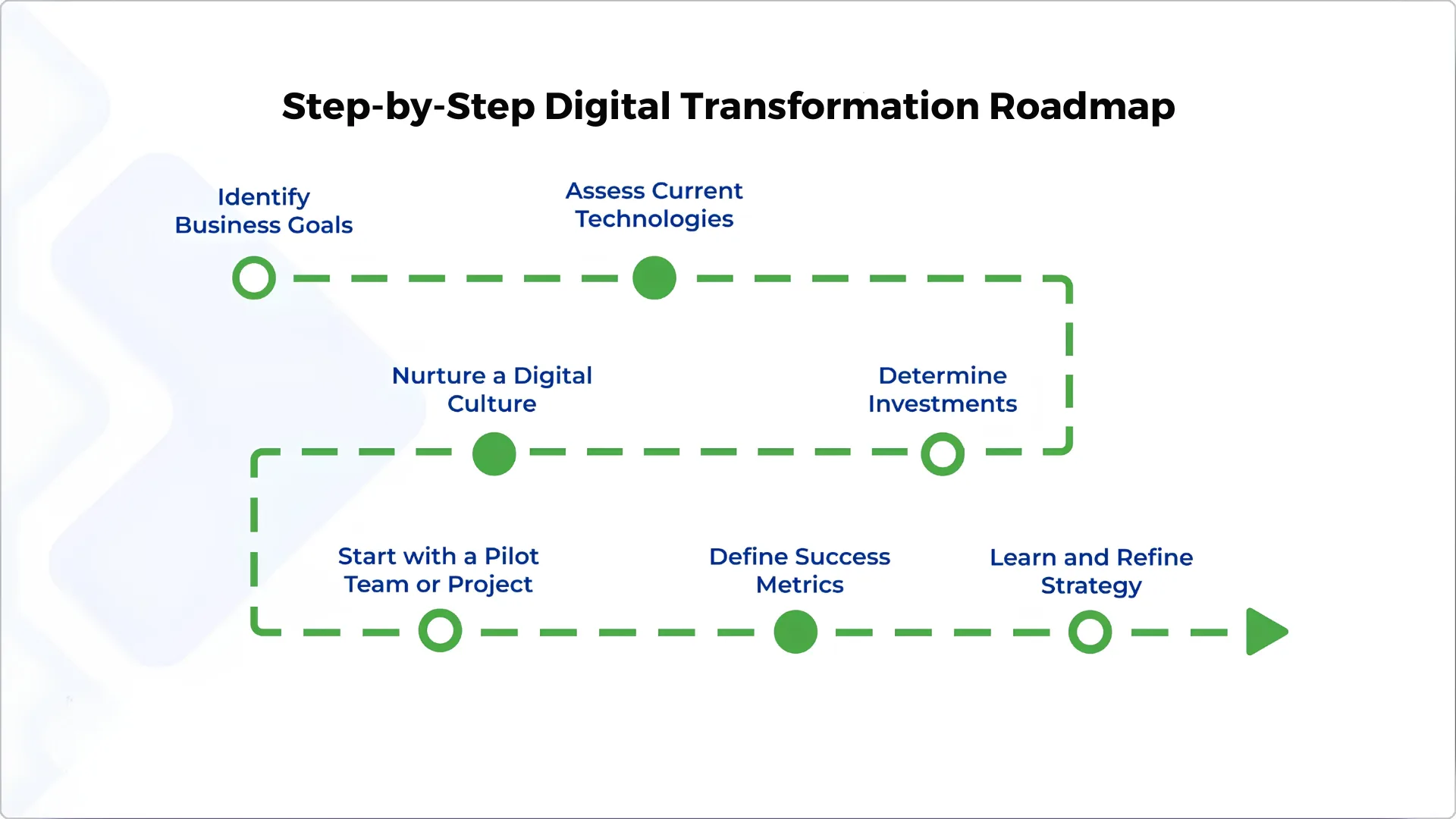
For the successful implementation of digital transformation in the industry without affecting the regular course of activities, the companies must follow a systematic approach to digital transformation:
Phase 1: Comprehensive Assessment and Strategy Design
Technology cannot be adopted simply because everybody is doing it. Look at your company and see what is working for you and what isn’t, such as machine downtime and waste. It is important to know which KPIs can be measured.
Phase 2: Establish the Digital Foundation
Invest in upgrading the plant infrastructure using industrial-grade Wi-Fi or 5G network technologies. Implement IIoT sensors on the machines you already have and choose a trusted cloud platform for data storage.
Phase 3: Implement Targeted Pilot Projects
Perform testing on a single manufacturing line or a critical machine, such as a predictive maintenance system. Analyze the results, address any identified issues, and explain how this procedure is useful.
Phase 4: Full-Scale Expansion and Training
Conducting successful pilot programs, implemented in all facilities. Train your staff to use digital technologies effectively.
Future of Smart Manufacturing
After 2026, smart manufacturing will progress very fast. Some manufacturers are exploring “dark factory” concepts, where highly automated production lines can operate with minimal human intervention. Generative
AI will create products from fundamental elements, while the cloud will handle optimization, testing, and the production of parts. Sustainability monitoring will also be automated, and AI-enabled monitoring systems may help manufacturers track energy consumption and support sustainability initiatives.
Conclusion
The manufacturing digital transformation has become an immediate necessity in 2026. Smart factories can cut costs by up to 40% through the use of cloud computing, IIoT, and artificial intelligence.
Even though there are various barriers to such a shift, such as the cost involved, compatibility issues with existing systems, and data security concerns, the benefits are enormous in the long run.
Those manufacturers that embrace this change early will be more competitive than those that do not.
FAQ’s
How exactly do smart factories cut costs by up to 40%?
Savings come from predictive maintenance that reduces downtime, AI-driven energy optimization that schedules equipment around lower electricity rates, and smart sensors that catch defects early to minimize material waste.
What technologies are essential for a smart factory?
Key technologies include cloud computing for centralized data storage, Industrial Internet of Things (IIoT) sensors for real-time monitoring, big data analytics, and digital twins for testing changes virtually before implementing them.
What are the biggest challenges manufacturers face when digitally transforming?
Common challenges include high upfront investment costs, difficulty integrating decades-old legacy equipment with new digital systems, and workforce resistance requiring training and change management.
What is the recommended approach to start a manufacturing digital transformation?
Start with a comprehensive assessment to identify KPIs and pain points, build the digital foundation with connectivity and IIoT sensors, run targeted pilot projects to prove value, then expand successful pilots company-wide with proper staff training.
What is a digital twin and how is it used in manufacturing?
A digital twin is a virtual replica of a machine or production line that lets manufacturers test changes, simulate performance, and identify issues without halting or risking the physical operation.
How does predictive maintenance differ from traditional maintenance schedules?
Traditional maintenance follows fixed time intervals regardless of actual equipment condition, while predictive maintenance uses real-time sensor data to service machines only when signs of wear or failure risk actually appear.
Can small and mid-sized manufacturers afford digital transformation?
While upfront investment is a real barrier, phased approaches starting with targeted pilot projects on a single line let smaller manufacturers prove ROI before committing to full-scale, plant-wide investment.
What role does AI play in manufacturing quality control?
AI-powered computer vision systems scan products at high speed using cameras, automatically detecting minute defects like scratches or dimensional errors far more consistently than manual visual inspection.
What is a “dark factory”?
A dark factory refers to a highly automated production facility that can operate with minimal to no human presence on the floor, relying on robotics, AI, and connected systems to run production autonomously.
How does IIoT connectivity work with older factory equipment?
Retrofit sensors can often be added to legacy machines to capture data like vibration and temperature without replacing the equipment entirely, though integration complexity varies depending on the machine’s age and design.