
It has become difficult to find competent technologists in today’s economic environment. The business needs to develop new products and maintain its current programs. This has led to remote hiring becoming a prevalent method for companies to form strong development teams.
If companies choose to hiring remote developers, India remains a favored destination owing to its large talent pool, strong technical expertise, and advanced digital infrastructure. India enables businesses to access skilled experts across a variety of technologies. These factors make India a perfect destination for software development worldwide.
Why Choose India for Remote Software Engineering?
The country has turned from a technology destination to an outsourcing center. The following are some reasons why most companies engage software engineering in India:
- Large Talent Pool: India creates over 1.5 million engineers each year. Thus, one can find developers of different levels of expertise.
- Strong English Skills: Most programmers use English throughout their studies and professional careers, making communication easier.
- Global Work Experience: Professionals are familiar with agile methodologies, project management techniques, and working practices abroad.
- Advanced Tech Ecosystem: A strong network of technology companies, startups, and GCCs is essential for developing highly scalable and innovative software solutions.
Cost Advantage Analysis
Cost-effectiveness is another reason companies prefer outsourcing developers from India. Companies will be able to lower their costs for salaries, space rentals, and infrastructure while still delivering high-quality development. Below is the table depicting the salaries for software developers annually in various regions, measured in USD:
| Experience Level | United States (USD / Year) | United Kingdom (USD / Year) | India (Remote) (USD / Year) | Average Savings Percentage |
| Junior Developer (1-3 Years) | $85,000 – $110,000 | $55,000 – $70,000 | $12,000 – $18,000 | 75% – 80% |
| Mid-Level Developer (3-6 Years) | $115,000 – $145,000 | $75,000 – $95,000 | $20,000 – $35,000 | 70% – 78% |
| Senior Developer (6+ Years) | $150,000 – $210,000 | $100,000 – $140,000 | $40,000 – $65,000 | 65% – 73% |
Important note: These costs are general market estimates. The amount to be paid varies depending on specialized expertise in fields such as Artificial Intelligence, Machine Learning, DevOps, Cloud Infrastructure, and Blockchain Technology.
Key Tech Hubs and Top Technical Skills Available
The Indian technology ecosystem is concentrated in only a few major cities, where highly qualified offshore software engineers work.
- Bengaluru (Bangalore): India’s leading tech hub known for its expertise in full-stack development, artificial intelligence, machine learning, and cloud architecture.
- Hyderabad: Hyderabad is one of the foremost centers of enterprise software engineers,cloud technology, database management, and data analytics.
- Pune and Mumbai: Strong hubs for FinTech solutions, banking applications, enterprise applications, and Web-based systems.
- Delhi NCR: Includes New Delhi, Noida, and Gurgaon. Very talented people in mobile application development and e-commerce solutions.
Companies can hire remote developers India with knowledge of the latest technology stack. They have experience with frontend technologies such as React, Angular, and Vue.js. These software engineers also know of backend technologies such as Node.js, Python, Java, NET, and Go. Many software engineers specialize in mobile technologies such as Swift, Kotlin, Flutter, and React Native. They are also skilled at providing cloud-based services such as AWS, Azure, and Google Cloud.
How to Hire Remote Developers in India: Step-by-Step
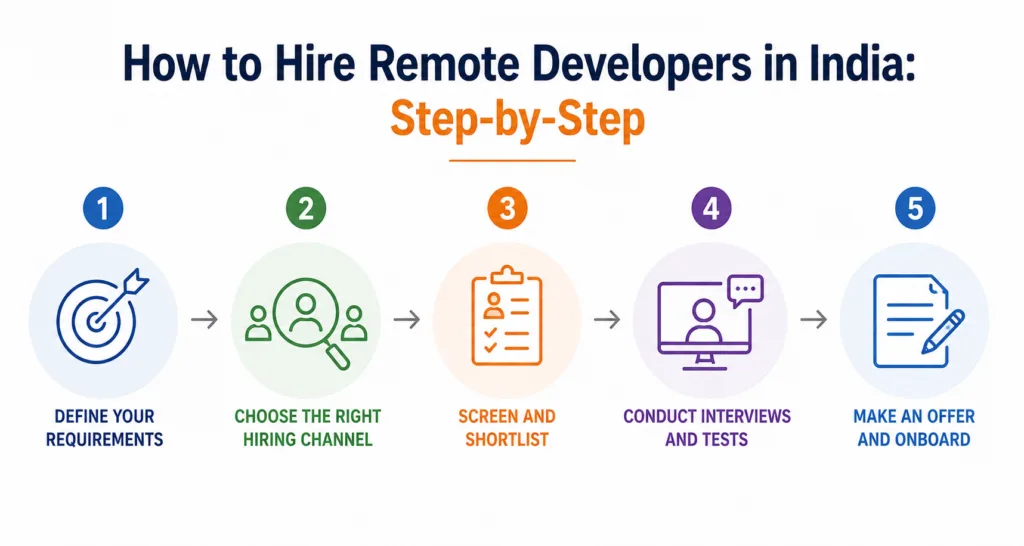
The recruitment process is vital for companies to hire the right candidate and prevent themselves from wasting money.
Step 1: Define Job Requirements
Establish clear specifications regarding the needed programming language, framework, experience level, and working hours.
Step 2: Choose a Hiring Channel
These sources can range from sites like LinkedIn, Naukri, freelancing websites, or even offshore recruitment agencies. The recruitment agencies would have screened the developers beforehand.
Step 3: Conduct Technical Assessments
Technical tests can be done using various online platforms like HackerRank or Codility.
Step 4: Hold Video Interviews
Analyze the technical expertise, problem-solving ability, communication skills, and style of programming exhibited by the applicant.
Step 5: Evaluate Remote Work Readiness
Analyze how well the candidate is able to work on his or her own initiative, manage time well, communicate with teams that are located remotely, and adjust to different time zones.
The use of the above methodology is sure to lead to successful deployment of remote developers in India to form effective remote development teams.
Common Engagement Models Explained
When businesses hire remote developers, they can use several engagement models depending on their priorities and managerial preferences.
Model A: Direct Freelancing
Hire independent developers on a short-term basis or for particular purposes. This strategy is convenient and economical, but it demands greater supervision and monitoring.
Model B: Dedicated Staff Augmentation
Partner with an Indian staff outsourcing agency that helps staff augmentation services to recruit full-time developers working only for you. The agency handles everything from payroll, infrastructure, while you handle all operations and development-related tasks.
Model C: Employer of Record (EOR)
With the help of EOR services, companies can hire developers in India without having an entity in India itself. In an EOR service, developers work within internal teams as contractors for EOR, which handles HR aspects, including payroll and benefits.
There are several benefits to each approach, enabling companies to build effective remote development teams in a balanced way.
Legal, Compliance, and Intellectual Property Safeguards
When outsourcing development to India, the security of IP and critical business information should be a top priority. Include these key safeguards in all agreements:
- IP Assignment: Specify that all the codes, designs, and other efforts made by the developers must be solely owned by your organization.
- Non-Disclosure Agreement (NDA): You should have an NDA signed before making any source codes, databases, and sensitive business information accessible.
- Data Security Compliance: Adhere to standards such as GDPR, HIPAA, or SOC 2. Make use of secure virtual private networks (VPNs), multi-factor authentication, and controlled access policies for security.
This reduces risk and ensures secure collaboration with off-site developers.
Managing and Communicating with Teams in India

Remote Software Engineering teams can become effective with good communication, documentation, and collaboration. Remote teams can leverage time zone differences to ensure consistent development.
- Asynchronous Documentation: Requirements for projects, user stories, and technical specifications should be stored in Notion or Confluence, where developers can access them independently.
- Overlapping Work Hours: Schedule at least 2–3 hours each day for meetings and discussions on code reviews and resolving critical issues.
- Project Tracking Tools: Implement project and requirement management using task management applications such as Jira and ClickUp, with clear acceptance criteria.
These strategies help businesses recruit developers from India and form productive, coordinated development teams.
Conclusion
Hiring remote developers in India is a great decision for companies operating internationally who wish to expand their software development operations. If you follow an organized recruitment process and have proper legal agreements and communication structures in place, your company can access a highly talented labor force.
Whether you want a competent developer for your application development, for migration of your organization’s IT infrastructure to the cloud, or to hire an engineering team of your choice, Indian developers could be the best pick for you.
FAQ’s
What is the average cost savings when hiring remote developers in India?
Companies typically save 65% to 80% compared to hiring equivalent talent in the United States or United Kingdom, depending on experience level, while still accessing highly skilled engineers.
What are the main ways to engage remote developers in India?
The three common models are direct freelancing for short-term needs, dedicated staff augmentation for full-time developers managed by an outsourcing partner, and Employer of Record (EOR) services for hiring without setting up a local entity.
How do I protect my intellectual property when outsourcing to India?
Include clear IP assignment clauses ensuring all code and designs belong to your company, sign an NDA before sharing sensitive information, and ensure the team follows data security standards like GDPR, HIPAA, or SOC 2.
How can businesses manage communication with a remote Indian development team effectively?
Use asynchronous documentation tools like Notion or Confluence, schedule 2-3 hours of daily overlapping work hours for critical discussions, and rely on project tracking tools like Jira or ClickUp with clear acceptance criteria.
Which Indian city should I look at for a specific technology specialty?
Bengaluru leads in AI, machine learning, and cloud architecture; Hyderabad excels in enterprise software and data analytics; Pune and Mumbai are strong for fintech; and Delhi NCR specializes in mobile and e-commerce development.
What is the difference between staff augmentation and Employer of Record (EOR)?
Staff augmentation partners with an agency that recruits and manages developers exclusively for you, while EOR lets you hire developers directly as your team members without establishing a legal entity in India, with the EOR handling local HR compliance.
How do I assess a remote developer’s readiness for asynchronous work?
Look for evidence of self-direction, strong written communication skills, comfort with documentation-heavy workflows, and prior experience collaborating across time zones during the interview process.
What technical assessment platforms are commonly used when hiring Indian developers?
Platforms like HackerRank and Codility are widely used to evaluate coding ability objectively before moving candidates forward to video interviews focused on problem-solving and communication.
How many overlapping work hours should I plan for with an Indian remote team?
Most companies find 2 to 3 hours of daily overlap sufficient for critical meetings, code reviews, and issue resolution, while relying on asynchronous documentation for the remainder of the workday.
Do salary costs in India vary significantly by specialization?
Yes. Specialized skills in AI, machine learning, DevOps, cloud infrastructure, and blockchain typically command higher rates than general full-stack development, even within the same experience bracket.