Designing the Workforce of the Future
For two decades, the GCC workforce playbook was built around one variable:
People.
More demand meant more hiring.
More capability meant more teams.
More scale meant more headcount.
That playbook is now being rewritten.
The reason is simple:
AI is no longer a tool the workforce uses.
It is becoming part of the workforce itself.
This creates a new category of capability center:
The AI-Native GCC.
And it raises the defining question of this series:
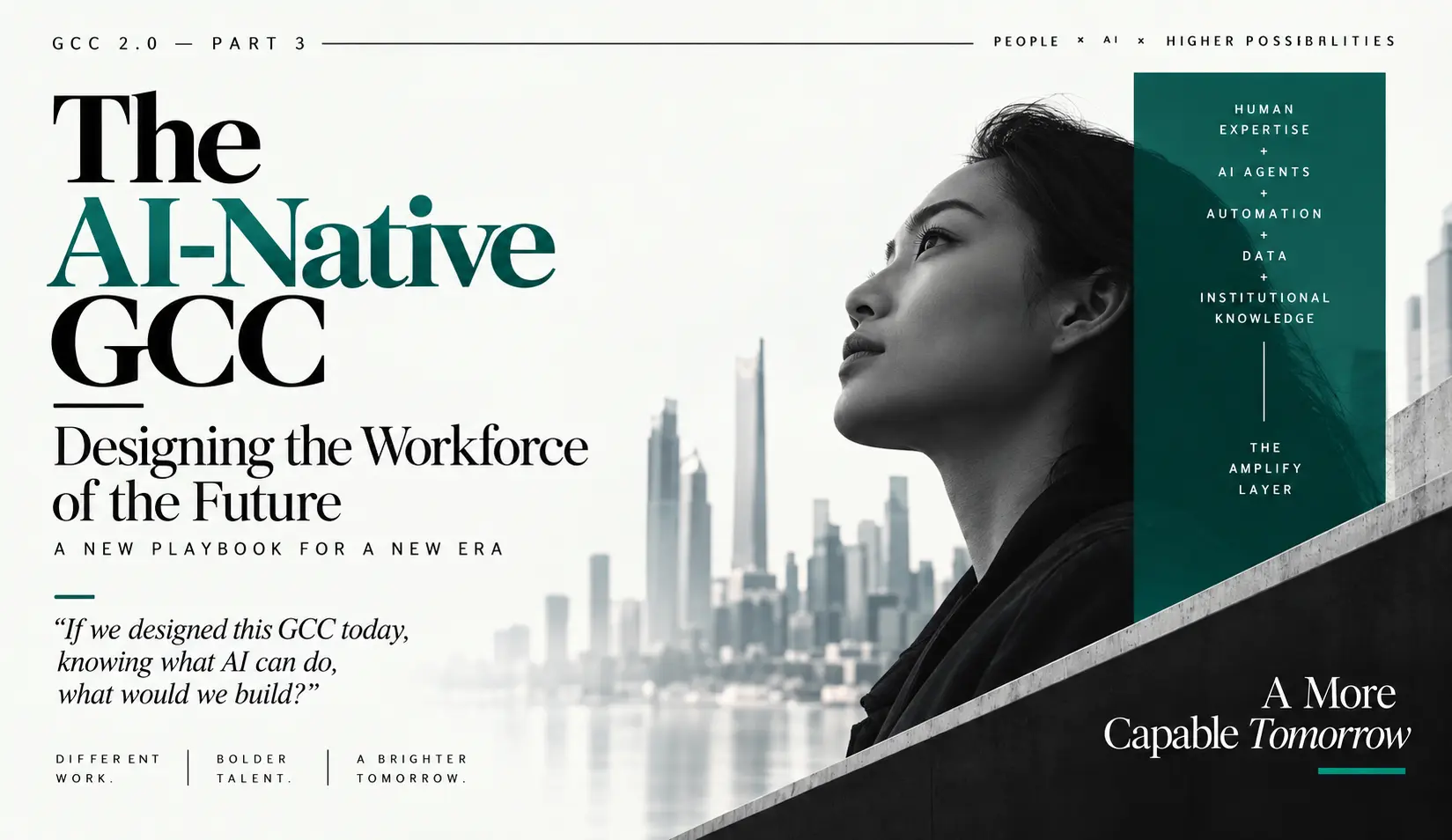
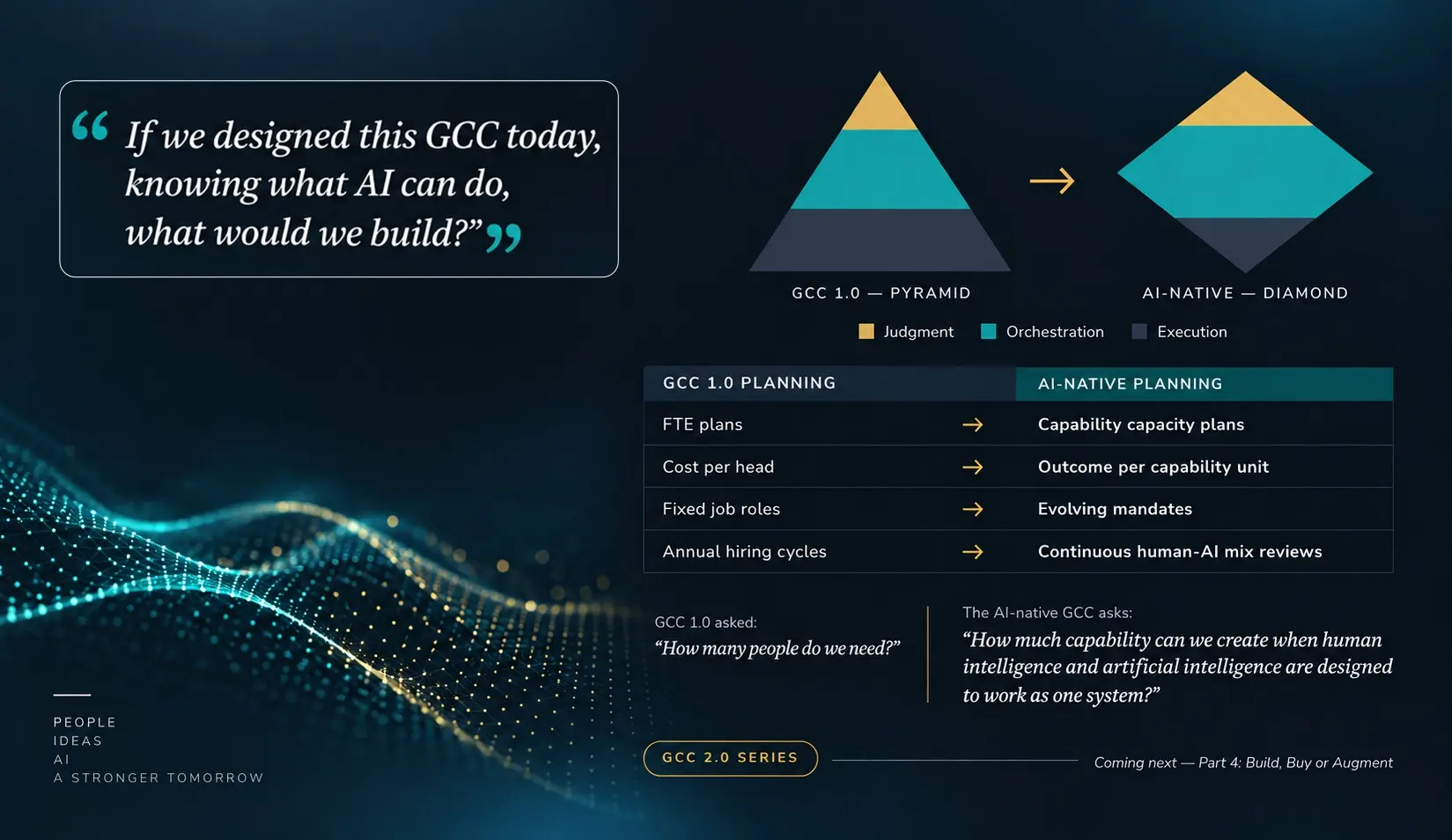
“If we designed this GCC today, knowing what AI can do, what would we build?”
The answer looks very different from the GCC of the last twenty years.
1. AI Adoption Is Not AI-Native Design
Almost every GCC today uses AI somewhere.
Copilots.
Chatbots.
Automated testing.
GenAI pilots.
That is AI adoption.
It is not AI-native design.
The difference matters, because the two produce completely different organizations.
An AI-adopting GCC asks:
“How can AI make our current teams faster?”
An AI-native GCC asks:
“How should work, teams and roles be designed when AI is a member of the workforce?”
The first question improves the existing model.
The second question replaces it.
2. Start With the Work, Not the Org Chart
The traditional GCC design exercise started with an org chart:
- How many developers?
- How many testers?
- How many analysts?
- How many managers?
The AI-native design exercise starts with a work chart:
What is the full inventory of work this GCC must deliver—and for each unit of work, what is the right combination of human judgment and machine execution?
When leaders run this exercise honestly, the results are striking.
In many technology and operations functions, a significant share of task volume can already be automated or AI-accelerated:
- Code generation and testing
- Document processing
- First-line analysis
- Reporting and reconciliation
- Knowledge retrieval
- Routine workflows
The implication is not fewer people doing the same work.
The implication is a different shape of workforce doing different work.
3. The Three-Layer AI-Native Workforce
The AI-native GCC workforce organizes into three layers.
Layer 1 — The Execution Layer
AI agents, automation and intelligent workflows handling high-volume, well-defined work. Humans review exceptions—not transactions.
Layer 2 — The Orchestration Layer
Professionals who direct AI systems, validate output and own quality.
Their skill profile is new:
- Workflow and prompt design
- Output evaluation
- Debugging machine-generated work
- Knowing when the machine is confidently wrong
Their productivity is a multiple of their predecessors’.
Layer 3 — The Judgment Layer
Architects, product owners, domain leaders and decision-makers who determine:
- What should be built
- What “good” looks like
- Where the enterprise should place its bets
Notice what changes in this model.
The large middle band of purely executional roles—the majority of a traditional GCC—shrinks every year.
The pyramid becomes a diamond.
4. The Amplify Layer
The AI-native GCC operates through a combination that will appear throughout this series:
Human expertise + AI agents + Automation + Data + Institutional knowledge
This is the Amplify layer.
The objective is not to replace people.
It is to increase what every person and every team can accomplish.
A 100-person organization equipped with the right AI capabilities can deliver outcomes that previously required significantly larger teams.
Which changes the fundamental planning unit:
| GCC 1.0 Planning | AI-Native Planning |
| FTE plans | Capability capacity plans |
| Annual hiring cycles | Continuous human-AI mix reviews |
| Cost per head | Outcome per capability unit |
| Pyramid org design | Diamond org design |
| Fixed job roles | Evolving mandates |
FTE planning becomes capability capacity planning.
5. Redesign the Entry-Level Role—Don’t Eliminate It
One consequence of AI-native design deserves special attention.
If AI increasingly absorbs repetitive entry-level work, the traditional GCC pyramid—hire thousands of freshers, promote a fraction—breaks.
The wrong response is to close the front door.
The right response is to redesign it.
The AI-native GCC:
- Hires fewer people at entry level
- Invests far more in each of them
- Equips them with AI from day one
- Moves them toward orchestration and judgment work faster
Entry-level talent does not become irrelevant.
It becomes a faster-moving investment.
6. New Functions the AI-Native GCC Must Build
AI as workforce creates functions that did not exist in GCC 1.0:
AI operations
Model evaluation, workflow monitoring, performance management of AI systems.
AI governance
Data, security, IP, model risk, human oversight, responsible AI.
Work design
Deciding, workflow by workflow, what is human, what is AI-assisted, what is automated.
Knowledge engineering
Turning institutional knowledge into an asset AI systems can use.
These functions belong inside the GCC—not only at headquarters.
The GCC that builds them becomes the enterprise’s AI operating-model laboratory.
7. Culture Is the Hard Part
The AI-native GCC asks people to change what they do—every year.
That is a cultural challenge before it is a technical one.
Centers that frame this as threat management will lose their best people.
Centers that frame it as the fastest route to higher-value work—and back that with real reskilling investment—will attract the strongest talent in the market.
The message that works is honest:
AI will change your role. It will also elevate it. And we will invest in getting you there.
8. The Economics Are the Forcing Function
Here is the strategic reality.
An AI-native GCC can deliver the output of a much larger legacy center with a smaller workforce operating at a fundamentally higher level.
Enterprises that rebuild around this model will convert the difference into:
- Innovation capacity
- New capabilities
- Faster transformation
Enterprises that keep running the headcount playbook will find themselves defending an operating model their competitors no longer carry.
The AI-native GCC is not a future concept.
It is a present design choice.
GCC 1.0 → AI-Native GCC
| GCC 1.0 Workforce | AI-Native Workforce |
| People as capacity | Human + AI as capability |
| Headcount plans | Capability capacity plans |
| Pyramid | Diamond |
| Execution mass | Orchestration + judgment |
| AI as a tool | AI as a workforce member |
| Annual workforce cycles | Continuous work redesign |
| Entry-level as volume | Entry-level as accelerated talent |
The CEO Questions
Before writing the next workforce plan, leaders should ask:
- What percentage of our current work could AI execute or accelerate today?
- Is our workforce plan denominated in outcomes—or in seats?
- Who owns human-AI work design as an explicit responsibility?
- Are we redesigning entry-level roles—or quietly eliminating our own talent pipeline?
- Would a competitor designing a GCC from scratch today build what we have?
The last question is the uncomfortable one.
Because somewhere, a competitor is designing exactly that center.
The Bottom Line
The workforce of the future is not coming to your GCC.
It is being designed right now—either by you, or by the competitor who gets there first.
GCC 1.0 asked:
“How many people do we need?”
The AI-native GCC asks:
“How much capability can we create when human intelligence and artificial intelligence are designed to work as one system?”
That is the workforce of the future.
That is GCC 2.0.
Coming Next—Part 4
Build, Buy or Augment: The New GCC Talent Strategy
If the AI-native GCC needs a fundamentally different workforce, the next question is how to create it.
Part 4 will examine how GCC leaders should decide what to build internally, acquire externally, or augment through AI and technology—and why the traditional “hire more people” talent strategy is no longer sufficient.
FAQ’s
What is an AI-native GCC?
An AI-native GCC integrates AI into its workforce, processes and technology from the ground up.
How is AI changing GCCs?
AI is automating routine work while enabling faster analysis, innovation and decision-making.
What skills will future GCC employees need?
AI literacy, data skills, problem-solving and strategic thinking will become increasingly important.
Will AI replace GCC employees?
AI is more likely to reshape roles by automating tasks and creating demand for new skills.
How can GCCs build an AI-ready workforce?
GCCs can focus on reskilling, AI training, talent development and human-AI collaboration.
What role does AI play in GCC operations?
AI can support automation, analytics, customer service, software development and other business functions.
Why is reskilling important for AI-native GCCs?
Reskilling helps employees adapt to changing roles and work effectively with AI technologies.
How can GCCs balance AI and human talent?
GCCs can combine AI capabilities with human creativity, judgment and domain expertise.
What are the benefits of an AI-native GCC?
Potential benefits include greater efficiency, faster innovation, improved scalability and stronger decision-making.
How can companies prepare for the future of GCCs?
Companies can develop an AI strategy, modernize technology and build a workforce ready for AI-enabled work.