Artificial intelligence is transforming the way organizations operate, helping them automate processes, improve decision-making, and deliver better customer experiences.
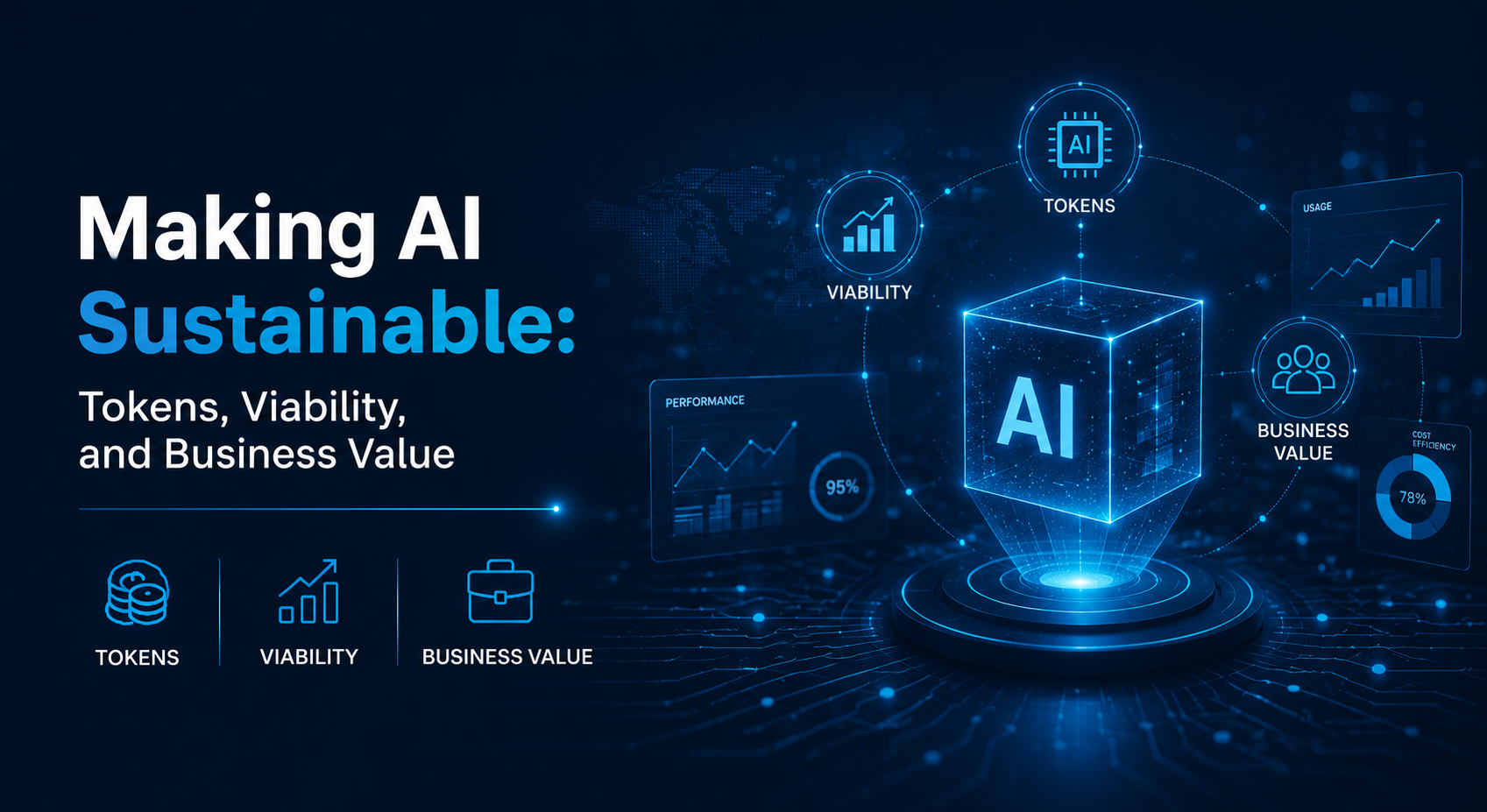
Managing token usage effectively not only reduces operational costs but also improves model performance, enhances user experiences, and ensures AI solutions remain viable as usage scales across the organization.
By optimizing token consumption, measuring the viability of AI initiatives, and aligning AI investments with measurable business outcomes, organizations can build scalable AI ecosystems that deliver long-term Business Value while maximizing return on investment.
Why Enterprise AI Success Depends on Efficiency, Economics, and Business Outcomes
Artificial Intelligence has moved rapidly from pilot projects to a core strategic capability. Organizations across sectors are investing in Generative AI, Agentic AI, intelligent automation, and AI-driven decision support to boost productivity, accelerate innovation, and improve customer experiences.
Yet as adoption scales, a new reality is emerging: deploying AI is often straightforward; sustaining its value at enterprise scale is hard.
The bottleneck is rarely technology or model capability. It is the lack of a disciplined strategy that balances innovation with operational efficiency, economic viability, and long-term business value.
The next phase of Enterprise AI will not favor those who deploy the largest models or consume the most AI services. It will reward organizations that deliver measurable outcomes while managing costs, governance, and scalability.
Tokens: The Hidden Currency of Enterprise AI
Behind every AI interaction lies a critical, often-overlooked resource: tokens.
Every prompt, document analyzed, response generated, and agent interaction consumes tokens. In modern AI platforms, token usage directly influences cost, latency, and system efficiency.
Think of tokens as the fuel that powers AI systems.
Just as organizations govern cloud infrastructure, storage, and compute, they must now manage Enterprise AI token consumption with equal rigor.
As AI spreads across functions, token usage can spike due to:
- Large contextual prompts
- Long conversation histories
- Multi-agent workflows
- Document-intensive processes
- Enterprise knowledge retrieval
Without governance, AI operating costs can outpace the business value created.
Organizations that treat tokens as a strategic business resource—not just a technical metric, will gain a durable edge in cost efficiency, scalability, and performance.
Why Process Optimization Matters More Than Model Selection
A common misconception in Enterprise AI is that success hinges on choosing the most advanced language model.
In practice, organizations often achieve greater gains by optimizing how AI is used rather than by switching models.
A well-designed workflow using an appropriately sized model can outperform a larger, costlier model running inefficiently.
Typical sources of unnecessary token consumption include:
- Repeating the same context in every request
- Overly long prompts with low signal
- Processing entire documents when only specific sections are needed
- Maintaining expansive conversation histories that inflate context windows
Instead of fixating on model benchmarks, organizations should invest in:
- Effective prompt engineering
- Context optimization
- Retrieval-Augmented Generation (RAG)
- Intelligent model routing
- Enterprise knowledge indexing
- Response-length management
The smartest AI strategy is rarely about the largest model—it is about the smartest process.
AI Must Be Economically Sustainable
Every technology investment eventually faces the same executive question:
Is this solution delivering measurable business value?
AI programs must meet the same financial discipline as other strategic investments. A sustainable AI initiative demonstrates four essential characteristics:
Business Value
The Enterprise AI solution should address a clearly defined business problem and deliver measurable outcomes, including productivity gains, faster decision-making, improved customer experiences, and revenue growth.
Cost Efficiency
Operational costs—including model usage, tokens, infrastructure, security, and maintenance—must remain sustainable as adoption scales.
User Adoption
Even the most advanced AI platform creates little value if employees and customers do not embed it into daily workflows.
Governance
Enterprise AI must operate within clear security, privacy, compliance, and ethical frameworks to build trust and minimize risk.
Organizations that focus only on technical capabilities often face rising costs, limited adoption, and unclear outcomes. Sustainable AI success comes from balancing innovation with measurable economic impact.
Measuring AI Return on Investment
Many organizations complete AI pilots successfully. Far fewer scale them enterprise-wide.
The difference lies in disciplined measurement.
An effective AI ROI framework starts by establishing a baseline for current performance: processing times, manual effort, operational costs, and error rates.
Next, quantify expected improvements in productivity, accuracy, customer experience, and decision speed—while accounting for all operational costs such as model licensing, token usage, infrastructure, compliance, and support.
Equally important is tracking user adoption. AI delivers value only when people consistently use it as part of their everyday workflows.
Continuous optimization should become routine. Monitoring token efficiency, response quality, model utilization, and operational effectiveness ensures AI continues to generate value long after deployment.
Deploying AI is not the finish line—it is the starting point of continuous improvement.
Architecture Determines Long-Term Economics
As AI deployments mature, architectural choices increasingly determine scalability, performance, governance, and total cost of ownership.
Successful organizations build AI platforms designed for efficiency from the outset.
Key architectural principles include:
- Selecting the right model for each task instead of defaulting to the largest
- Retrieving only relevant enterprise knowledge rather than inflating prompts
- Building centralized knowledge repositories reusable across applications
- Designing collaborative multi-agent workflows while minimizing unnecessary token exchanges
- Establishing enterprise-wide standards for prompt engineering, model selection, governance, and security
These practices reduce costs, improve scalability, strengthen governance, accelerate response times, and broaden adoption.
Ultimately, every token consumed should contribute directly to measurable business value.
The Future of Enterprise AI
The first generation of Enterprise AI focused on building larger models with bigger datasets.
The next generation will focus on building smarter systems.
Organizations are already shifting toward specialized task-specific models, intelligent model orchestration, collaborative AI agents, and knowledge-centric architectures that leverage proprietary business information rather than simply scaling model size.
Future AI platforms will intelligently determine:
- Which model should process a request
- How much context is actually required
- Which enterprise knowledge should be retrieved
- How to optimize cost, speed, and quality simultaneously
The competitive advantage will no longer belong to organizations that consume the most AI. It will belong to those that orchestrate AI most intelligently.
Conclusion
Artificial Intelligence is becoming as fundamental to business as cloud computing and data analytics. But sustainable success requires more than deploying powerful models.
A sustainable AI strategy ensures that innovation remains scalable, cost-effective, and capable of delivering measurable business value over the long term.
Organizations must optimize token consumption, design efficient workflows, measure economic viability, establish strong governance, and continuously improve performance.