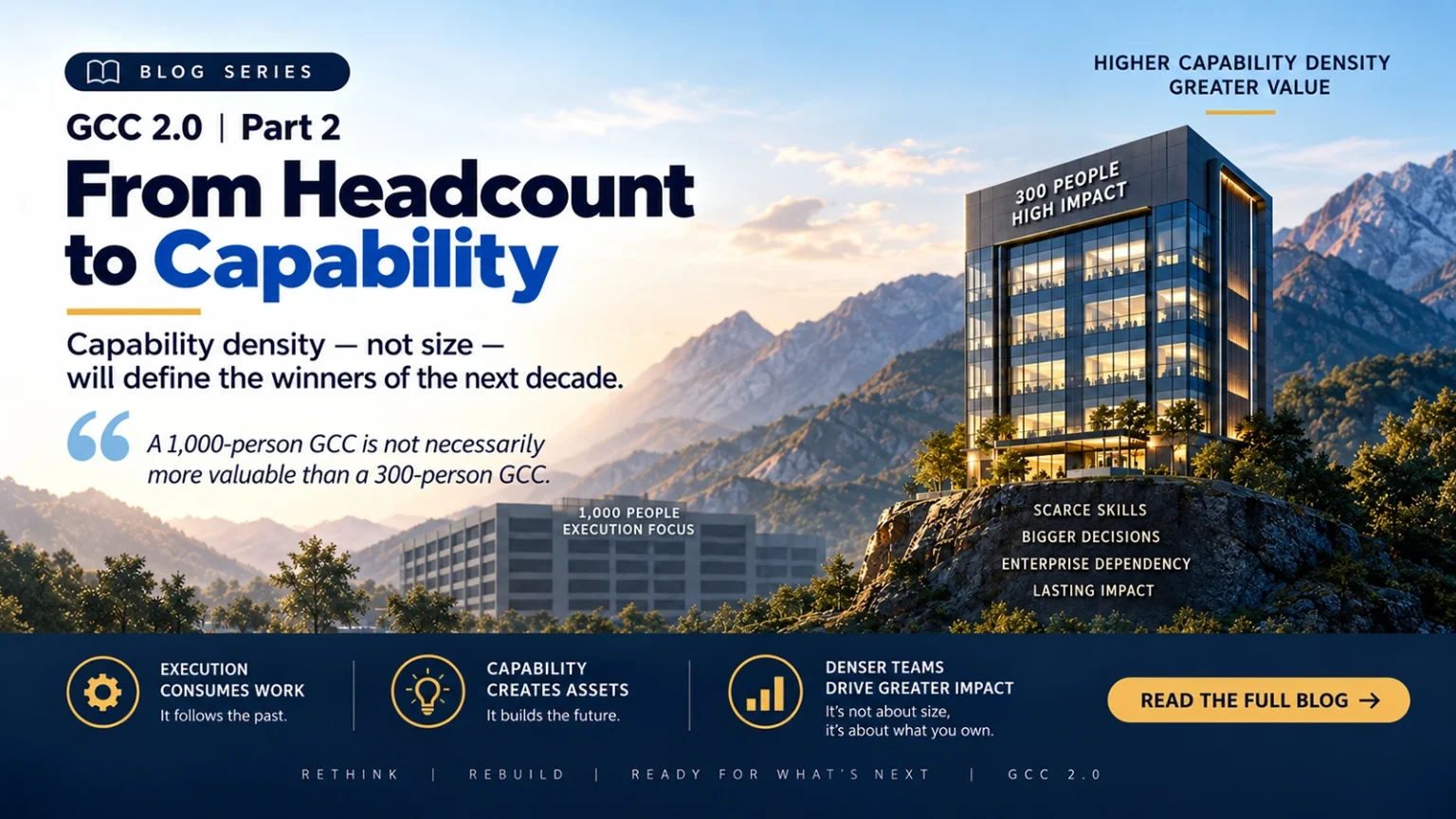
Capability density – not size – will define the winners of the next decade.
A 1,000-person GCC is not necessarily more valuable than a 300-person GCC.
Read that again, because it cuts against everything the industry has celebrated for twenty years. We ranked GCCs by headcount. We announced expansions in thousands of seats. We treated the hiring plan as the strategy. And for the first era of global capability centers, that logic mostly worked – scale was the point, because the model was execution at cost.
But if Part 1 of this series argued that the GCC is evolving from execution to ownership, then Part 2 must answer the harder question: what actually creates value in an ownership-driven GCC?
The answer is not more people. The answer is what those people own that the enterprise cannot do without.
The Headcount Trap
For most of GCC history, headcount was a perfectly rational proxy for value. If the mission is to execute defined work at lower cost, then more people means more work absorbed, which means more savings. The metrics followed the mission: seats filled, utilization rates, cost per FTE, attrition. Every one of them is a measure of capacity.
Here is the uncomfortable part. Capacity is now the most replaceable thing a GCC offers. It can be benchmarked against outsourcing providers, arbitraged across geographies, and – increasingly – automated outright. A GCC whose value proposition is “we have 2,000 people who execute reliably” is defending a position that erodes every year.
And there is a second, more human dimension to this trap. Most GCC leaders are still measured on headcount. Their budgets scale with it. Their internal status, their band, their seat at regional leadership forums – all of it has historically tracked the size of the organization they run. So when we say the future belongs to smaller, denser, more capable centers, we are not describing a neutral operating-model shift. We are describing something that feels threatening to the very people who must lead it.
That tension deserves to be named, not managed around. The leaders who navigate GCC 2.0 successfully will be the ones who change what they ask to be measured on – before someone else changes it for them.
Capability Density: The New Unit Of GCC Value
If headcount is the old unit of value, what is the new one?
I would propose capability density: the concentration of strategic capability, proprietary expertise, and genuine decision ownership per person in the GCC.
To keep this from becoming another consulting abstraction, think of capability density as the product of three things:
Scarcity. What share of your GCC’s work could the enterprise buy off the shelf tomorrow – from a service provider, a SaaS product, or an AI tool? Whatever remains after that subtraction is your scarce capability. A GCC running standardized finance processes has low scarcity. A GCC that houses the enterprise’s pricing science, its supply-chain risk models, or the product engineering for a revenue-generating platform has high scarcity.
Decision altitude. What is the most consequential decision made inside your GCC last quarter without headquarters sign-off? Not escalated, not recommended – made. If the honest answer is a staffing decision or a process tweak, decision altitude is low, regardless of how senior your titles are. If the answer is a product roadmap call, a platform architecture choice, or a market-facing commitment, altitude is high.
Enterprise dependency. If your GCC disappeared tomorrow, what would break – and how long would it take the enterprise to notice? A capacity-driven center creates a backlog. A capability-dense center creates a crisis.
A 300-person GCC that scores high on all three is worth more to the enterprise than a 1,000-person GCC that scores low – not marginally more, but categorically more. One is an asset the enterprise builds strategy around. The other is a line item the enterprise periodically re-tenders.
A Self-Diagnostic For GCC Leaders
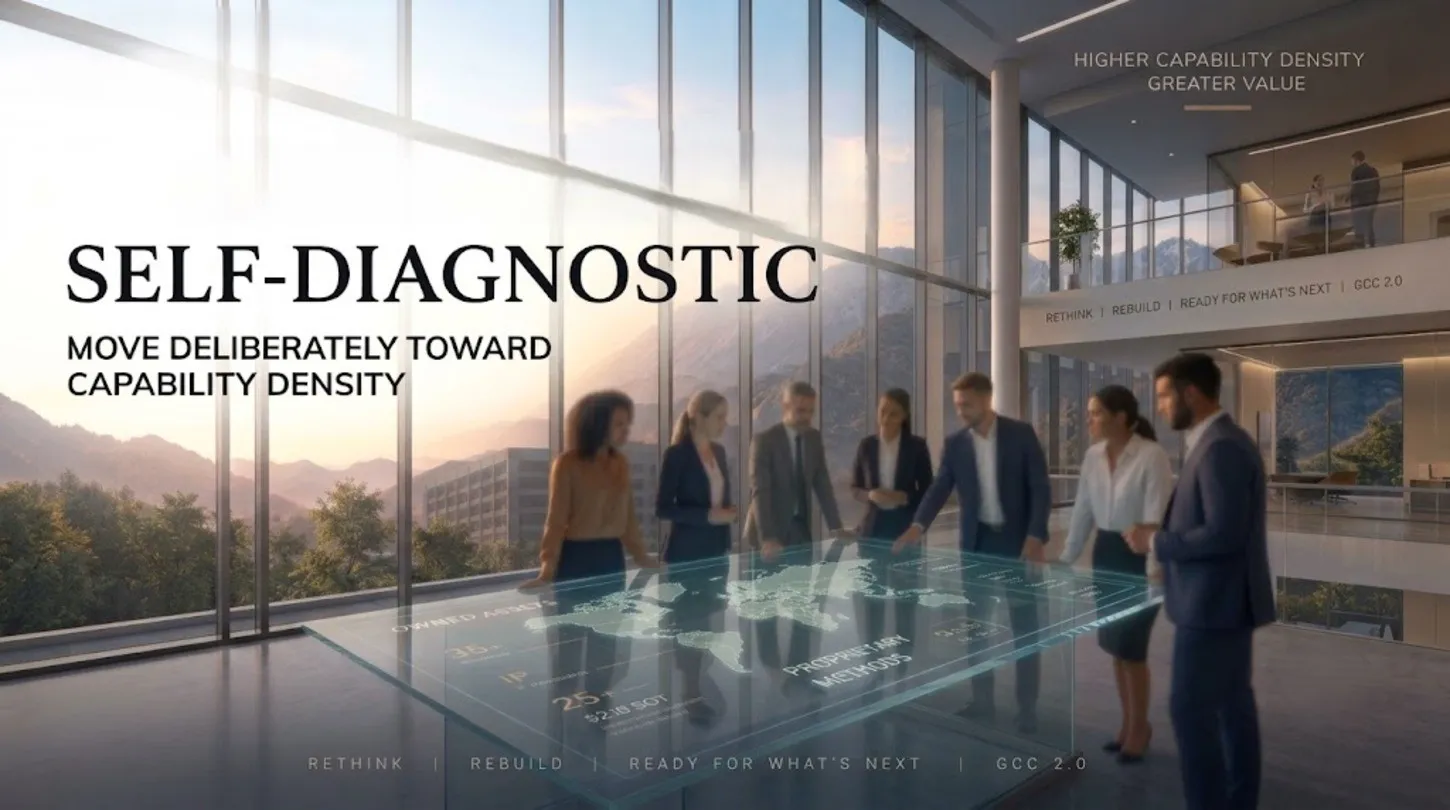 Capability density becomes useful the moment a leader can assess it honestly. Three questions do most of the work:
- What do we own outright? Not support, not enable, not partner on – own, with accountability for the outcome. List the capabilities where the GCC is the enterprise’s answer, not a contributor to someone else’s answer. If the list is short, that is your starting point, not your verdict.
- What have we built that didn’t exist before us? Intellectual property, proprietary methods, platforms, data assets, patents, reusable frameworks. Execution consumes work; capability creates assets. A center that has operated for ten years and can point to no asset it created has been running on capacity the whole time.
- Where does the enterprise come to us first? When a new problem emerges – a new market, a new technology, a new regulatory demand – is the GCC in the first conversation or the last handoff? First-conversation status is the clearest external signal of capability density, because it reflects what the rest of the enterprise actually believes about you, not what your charter says.
A GCC leader who runs this diagnostic annually, and moves each answer deliberately, is building GCC 2.0 whether or not they use the label.
What Changes When Capability Leads
Once capability replaces headcount as the unit of value, the rest of the operating model follows – not as a menu of parallel initiatives, but as consequences of that single shift.
Utilization gives way to business outcomes, because a capability is only real if it moves an enterprise result. You cannot claim to own pricing science and report success in billable hours. The metrics of a capability-dense GCC look like the metrics of the business it serves: revenue influenced, risk reduced, time-to-market compressed, margin created.
Skills give way to differentiated expertise, because scarce capability cannot be staffed from a generic talent pool. The hiring question changes from “can we fill 200 roles this quarter?” to “can we assemble the fifteen people who make this capability world-class?” Depth beats breadth. The talent strategy starts to resemble a research lab’s more than a delivery organization’s.
Managers give way to decision owners – the theme of Part 1 – because decision altitude cannot rise inside a structure built to supervise execution. Capability is the cause; ownership is what it looks like organizationally. You cannot have one without the other, which is why centers that announce “ownership” without building scarce capability end up owning nothing anyone else wanted.
And human capacity gives way to human-plus-AI capacity – but that shift is large enough, and disruptive enough, to deserve its own chapter. More on that in a moment.
The Question Every GCC Leader Should Be Asking
Strip everything else away and Part 2 comes down to a single question worth putting in front of your leadership team:
Are we building a bigger GCC – or a more valuable enterprise capability?
These sound like the same goal. They are not, and the difference shows up in every decision. A bigger GCC hires ahead of demand; a capability builder hires ahead of ambition. A bigger GCC celebrates seat count; a capability builder celebrates the first decision the enterprise moved to the center permanently. A bigger GCC measures itself against other GCCs; a capability builder measures itself against the best team in the world at the thing it owns.
The first era of GCCs answered “how much can you do for us?” The next era answers “what can you do that no one else can?”
The Bridge to Part 3
There is one thread I have deliberately left hanging.
If capability – not headcount – is the unit of GCC value, then a genuinely disruptive question follows: what happens when AI can multiply capability without adding a single person?
For the first time, a GCC can raise its capability density without raising its headcount at all – when every analyst carries the leverage of a team, and every scarce expert’s judgment can be encoded, scaled, and deployed across the enterprise. That is not an efficiency story. It is a redefinition of what a “center” even is.
That is the subject of Part 3: How AI changes the GCC operating model — from human capacity to human + AI capability.