
Building a Global Capability Center (GCC) is no longer difficult because talent is unavailable. Organizations can hire engineers, establish delivery teams, access technology talent and create centers of excellence.
Yet not every GCC becomes a strategic enterprise capability. Some remain trapped in execution, some become large but bureaucratic, some continue to be measured primarily on cost, and others struggle to demonstrate why they should own critical capabilities globally.
The difference is rarely the initial talent pool. It is the leadership model, operating model and strategic intent behind the GCC.
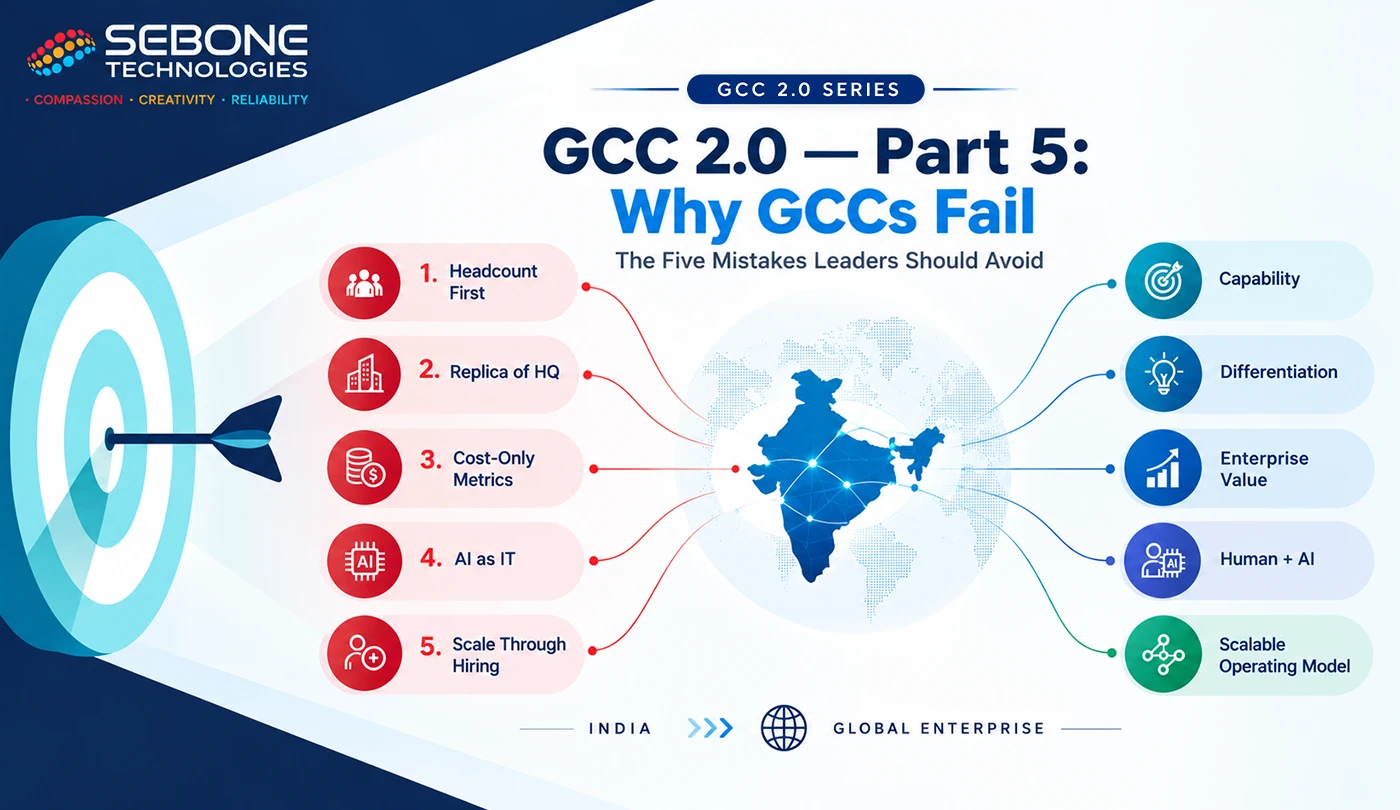
As organizations move from GCC 1.0 to GCC 2.0, five recurring mistakes can prevent a center from becoming a strategic capability engine.
1. Starting With Headcount Instead of Strategy
One of the most common mistakes is starting the GCC conversation with a number: “We need 100 people.” Then the target becomes 250, followed by 500. Headcount gradually becomes the primary measure of progress.
But headcount is an input—not an outcome. A GCC can grow from 100 to 1,000 employees without developing a single strategically differentiating capability.
A better starting question is: What should the enterprise be capable of doing because this GCC exists?
Business priorities → Strategic capabilities → Work → Skills → Workforce
This is a stronger planning sequence than starting with headcount, building teams and then assigning tasks. It helps determine whether the GCC becomes a capability engine or simply a larger delivery center.
GCC 2.0 principle: Capability first. Headcount second.
2. Becoming a Replica of Headquarters
Another common mistake is treating the GCC as a smaller version of the parent organization. Headquarters has a structure, hierarchy and functional silos, and the GCC simply reproduces them.
This may feel safe, but it wastes one of the biggest advantages of a GCC: the ability to design something differently. A GCC should complement the global organization—not duplicate it.
For example, the GCC could become the enterprise’s center of excellence for:
- AI engineering
- Data platforms
- Cloud transformation
- Cybersecurity
- Digital products
- Platform engineering
- Automation
- Advanced analytics
The objective is distinctive ownership. If the GCC is doing exactly what another part of the organization already does, its strategic value becomes harder to demonstrate.
GCC 2.0 principle: Don’t replicate capability. Create differentiated capability.
3. Measuring Success Through Cost Savings Alone
Cost efficiency matters, but it cannot be the long-term definition of GCC success. A GCC that saves $20 million but creates no strategic capability may ultimately be less valuable than one that generates savings while also developing an enterprise platform, launching products, improving customer experience or creating proprietary intellectual property.
This requires a broader measurement framework that connects GCC performance to business outcomes.
| GCC 1.0 metrics | GCC 2.0 metrics |
|---|---|
| Cost per FTE | Business outcomes |
| Headcount | Revenue enabled |
| Utilization | Productivity created |
| Delivery efficiency | IP generated |
| Savings | Products and platforms owned |
| — | AI adoption and automation impact |
| — | Time-to-market and innovation |
| — | Critical capabilities developed |
The key shift: Move from asking “How much does the GCC cost?” to asking “How much enterprise value does the GCC create?”
This is one of the most important mindset shifts for GCC leadership.
4. Treating AI as Another IT Initiative
Many organizations are adding AI to their GCC strategy without changing the GCC itself. They create an AI team, launch generative AI pilots, deploy copilots and automate selected processes—then return to the existing operating model.
However, AI can change much more than individual tasks. It can reshape work design, team structures, decision-making, productivity, talent requirements, knowledge management and operating economics.
AI therefore needs to become part of the workforce model, rather than sitting beside it.
Human + AI + Automation + Data + Platforms
This is the Amplify layer. The objective is not simply to reduce people; it is to increase what each person and each team can accomplish.
- A developer equipped with AI works differently from a developer working without it.
- A business analyst with intelligent data tools operates differently from one relying entirely on manual analysis.
- A service organization using AI agents has a fundamentally different capacity model.
GCC 2.0 principle: Don’t add AI to the operating model. Redesign the operating model around AI.
5. Scaling People Before Scaling the Operating Model
The fifth mistake often appears after early GCC success. A center starts with 50 people and the model works, so leadership scales to 100, 250 and then 500.
As the center grows, communication can slow, decision-making can become complicated, managers multiply, handoffs increase and governance becomes heavier. The organization becomes busy—but not necessarily more productive.
This happens because organizational complexity can grow faster than headcount. Scaling therefore requires more than recruitment.
Before a GCC grows significantly, leaders should define:
- Decision rights and accountability
- Governance and global interfaces
- Leadership structure
- Technology architecture
- Automation strategy and AI integration
- Capability ownership
- Performance measurement
GCC 2.0 principle: Scale the operating model before scaling the workforce.
The Five GCC Mistakes at a Glance
| Common mistake | GCC 1.0 thinking | GCC 2.0 thinking |
|---|---|---|
| Starting with headcount | How many people do we need? | What capability do we need? |
| Replicating headquarters | How do we copy headquarters? | What should the GCC uniquely own? |
| Cost-only measurement | How much can we save? | What enterprise value can we create? |
| Treating AI as IT | Where can we deploy AI? | How should AI redesign the workforce? |
| Scaling through hiring | How quickly can we add people? | How should the operating model scale? |
The Real Reason GCCs Fail
The deeper issue behind these five mistakes is simple: many organizations establish a GCC 2.0 ambition using a GCC 1.0 operating model.
They want innovation, AI leadership, product ownership, strategic influence and global capability. But they continue to manage the center through headcount, cost, utilization, hierarchy, functional silos and traditional workforce planning.
The ambition and the operating model are disconnected. That is where GCC transformation gets stuck.
The CEO Test: Five Questions GCC Leaders Should Ask
Before approving the next phase of GCC investment, CEOs and enterprise leaders should ask five questions:
What strategic capability will this GCC own?
If the answer is unclear, the GCC may simply be adding capacity.
What will this GCC do better than the rest of the organization?
If there is no clear answer, differentiation is missing.
How will AI change the workforce model?
If AI is simply another technology initiative, the transformation is incomplete.
How will we measure enterprise value?
If the scorecard is still primarily cost and headcount, the GCC remains anchored in GCC 1.0.
Can the operating model scale without proportional headcount growth?
If the answer is no, growth may create complexity faster than value.
From Cost Center to Capability Engine
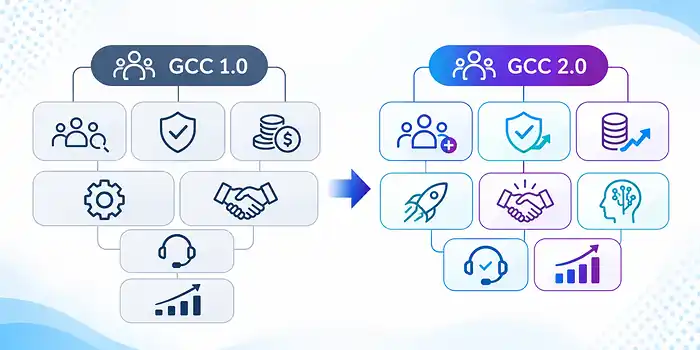
The journey from GCC 1.0 to GCC 2.0 can be viewed as a series of transitions:
| GCC 1.0 | GCC 2.0 |
|---|---|
| Headcount | Capability |
| Execution | Ownership |
| Cost | Value |
| People | Human + AI |
| Delivery | Innovation |
| Support | Strategic partnership |
| Scale | Capability velocity |
This is not simply a technology transformation. It is an enterprise operating-model transformation—and that is why GCC leadership has become a CEO-level topic.
The GCC 2.0 Leadership Imperative
The winning GCC will not necessarily be the one with the largest workforce. It will be the one that can answer three questions better than its peers:
What should we own?
How should we build it?
How can we scale it intelligently?
The answer requires a new combination of talent, technology, AI, operating model and leadership. When these elements work together, the GCC becomes much more than a delivery center. It becomes an enterprise capability engine.
The conversation then changes from “How much can India deliver for us?” to “What can our GCC enable the global enterprise to become?”
That is the real promise of GCC 2.0.
Coming Next — Part 6
Scaling a GCC from 50 to 500: The Operating Model Challenge
Starting a GCC is one challenge. Scaling it is another. What works at 50 people can break at 500.
Part 6 will explore how GCC leaders can design the operating model, governance, leadership structure and capability architecture required to scale without allowing complexity to consume the benefits of growth.