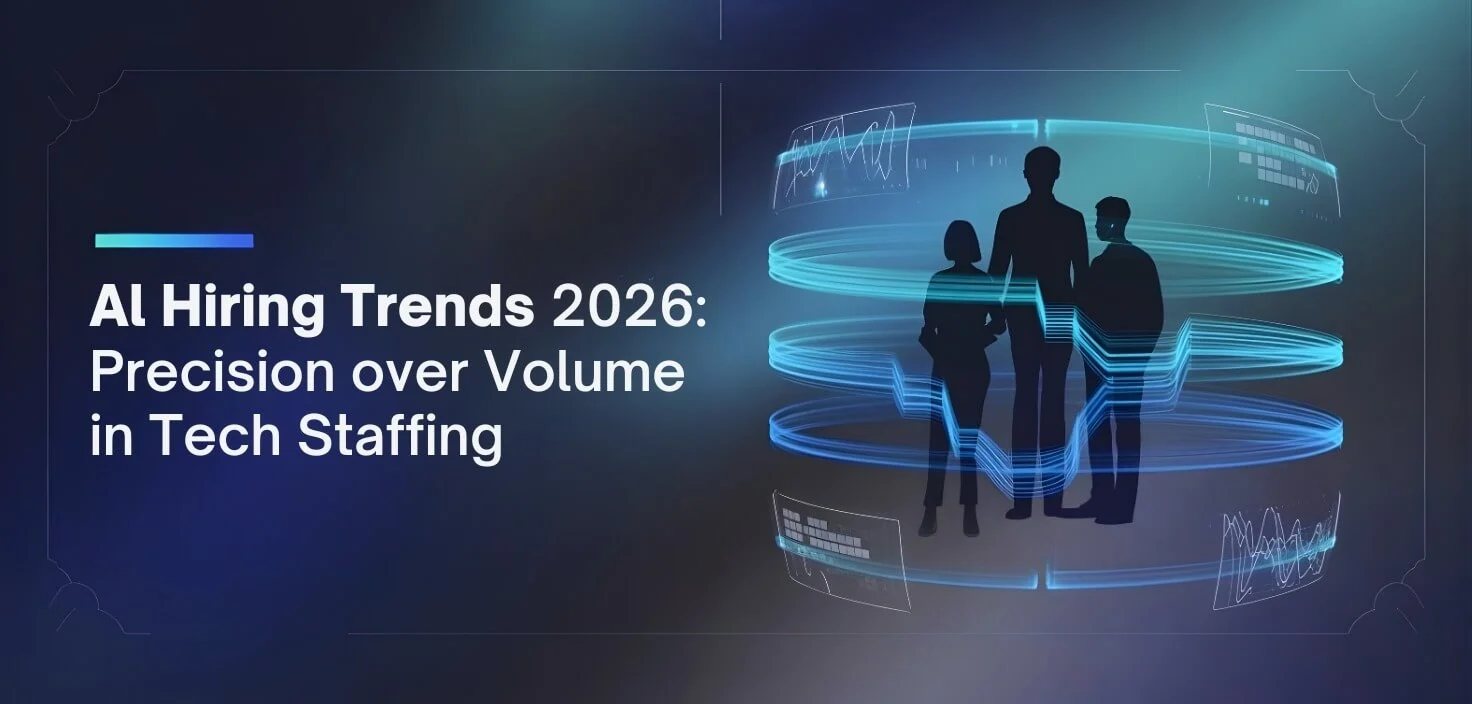
Artificial Intelligence is advancing rapidly, with new models launching frequently and enterprises adopting AI faster than ever. Automation is now embedded across modern business operations. However, AI hiring trends in 2026 tell a different story than expected.
Instead of mass hiring, enterprises are becoming more selective. The focus has shifted from building large teams to hiring smaller, highly skilled professionals who can deliver measurable results.
At Sebone Technologies, this shift is visible across staff augmentation engagements in pharmaceutical sciences, semiconductors, and advanced technology. Companies are no longer hiring based on potential alone, but on proven ability to create real business value.
The New Reality of AI Hiring in 2026
Artificial intelligence (AI) is no longer limited to experimentation or innovation labs. What once began as pilot projects has now become a core part of how organizations operate, make decisions, and scale technology-driven processes.
Today, AI is embedded into essential business functions such as manufacturing operations, drug development, regulatory compliance, and enterprise data analysis. It directly influences productivity, accuracy, and long-term competitiveness across industries.
As AI becomes central to business strategy, recruitment approaches are also evolving. Companies are no longer hiring AI talent for exploration, they are hiring to deliver real, measurable outcomes.
1. Hiring staff with strategic decision-making abilities.
2. Employing staff who know how to integrate AI with the existing systems of the company.
3. Looking for people with specific expertise related to the domain they work in.
4. Looking for people with the right skills to work in a highly regulated and complex environment.
As a result, the need for large execution-focused teams is decreasing. Companies are now seeking specialists who can guide AI initiatives from concept to deployment. More importantly, they want professionals who can ensure these initiatives deliver measurable business results.
Understanding the Layoff–Demand Paradox
One of the most confusing signals in today’s job market is the coexistence of layoffs and high demand for AI talent. Headlines frequently highlight workforce reductions, while hiring managers struggle to fill critical roles, reflecting shifting AI hiring trends.
This is not a contradiction; it’s a restructuring.
What’s Really Changing?
- Routine and execution-heavy roles are being automated or consolidated
- AI tools handle repetitive coding, testing, and data processing tasks
- Demand is rising for professionals who provide judgment, oversight, and integration
As a result, overall job postings decline, but demand surges for specific, high-impact skills. The issue is not a lack of talent, it’s a mismatch between available skills and real-world requirements.
In 2026, companies are no longer asking, “Can this person do the task?” They are asking, “Can this person deliver outcomes?”
Why Generic Tech Roles Are Shrinking
Traditional tech hiring relied heavily on entry-level and junior roles to handle foundational tasks. However, AI has dramatically compressed the learning curve for these responsibilities.
Basic development, documentation, data preparation, and quality checks can now be accelerated with AI-powered tools. This reduces the need for large junior teams and raises expectations for new hires.
What Employers Expect Today
- Immediate productivity
- Strong domain understanding alongside technical skills
- Experience working with AI-assisted workflows
- The ability to adapt tools to real business constraints
In sectors like pharma staffing and semiconductor talent placement, these expectations are even higher. AI professionals must understand regulatory compliance, validation protocols, data security, and industry-specific standards, often from day one.
AI Hiring in Regulated and High-Stakes Industries
AI adoption in regulated industries comes with unique challenges. Unlike consumer technology, errors in pharmaceuticals or semiconductor manufacturing can lead to compliance failures, safety risks, or financial losses.
As a result, AI hiring in these sectors demands exceptional discipline.
Professionals must be capable of:
- Operating within strict regulatory frameworks
- Ensuring data integrity and audit readiness
- Balancing innovation with risk management
- Collaborating across engineering, legal, and operational teams
This is why precision hiring matters so much. A single misaligned hire can slow projects, increase risk exposure, or derail AI initiatives entirely.
Common AI Hiring Pitfalls in 2026
As companies adjust to this new hiring reality, several recurring challenges emerge.
1. Unclear Role Definitions
Many organisations know they need AI talent but struggle to define which roles actually drive ROI. This leads to overhiring or misaligned job descriptions.
2. Overreliance on Buzzwords
Certifications, trending tools, and impressive resumes often mask a lack of applied experience. Real AI value comes from execution in live environments, not theory.
3. Weak Performance Assessment
Traditional interviews are poorly suited to evaluate AI readiness amid evolving AI hiring trends. Without practical, scenario-based assessments, predicting on-the-job success becomes difficult.
These pitfalls slow time-to-value and increase hiring costs, especially in specialised industries.
Why Precision Hiring Delivers Better ROI
Precision hiring prioritises the match of skills, experience, and business objectives. While many businesses create massive teams of resources, precise hiring involves investing in people who can:
- Own AI systems end-to-end
- Translating Business Requirements to Technical Execution
- Integration of existing infrastructures with AI
- To provide measurable efficiencies, accuracy, or compliance
Such a process not only helps minimise the overhead but also increases the rate of success for the projects. Teams that consist of a smaller number of people and are well-aligned have a higher probability of success compared to those that are not.
How Sebone Technologies Enables AI-Ready Staff Augmentation
At Sebone Technologies, our philosophy of staff augmentation centres on this practice of precision. We assist clients in moving beyond the generic hiring practice by providing professionals who are prepared to function in real-world AI environments immediately.
Our Differentiated Approach Includes:
- Tracing outcome-driven role scoping to business goals
- Stringent vetting based on practical experience
- ISO 27001 conference on compliance with security requirements
- Specialized screenings for pharma, semiconductor, and legal domains
- Talent matching that emphasizes execution, responsibility, and alignment
Instead of filling seats, we assist organizations in developing AI-enabled teams that produce results
The Future of AI Hiring: Fewer Roles, Greater Impact
AI is not eliminating jobs, it is redefining them. In 2026, success belongs to organizations that understand this distinction.
Winning companies will:
- Hire fewer but higher-impact professionals
- Focus on roles tied directly to outcomes
- Treat hiring as a strategic lever, not a volume exercise
- Align talent decisions with long-term AI roadmaps
This evolution is not driven by hype. It is driven by necessity.
Final Thoughts: Precision Is the Competitive Advantage
AI hiring trends in 2026 reflect a maturing market. The question is no longer how fast companies can hire, but how effectively they can deploy talent. Precision beats volume. Fit beats speed. Outcomes beat activity.
Organisations that embrace disciplined, outcome-focused hiring will extract real value from AI, while others struggle with misalignment and inefficiency.
If you are navigating AI hiring challenges or rethinking your staffing strategy, a precision-driven approach can make all the difference. For a broader look at building the right hiring stack, see our related read on top recruiting solutions every growing business should use in 2026.
Book a Free AI Hiring Audit or Explore Our Services to gain clarity and stay ahead in 2026.
FAQ’s
Why are companies hiring fewer but more specialized AI professionals in 2026?
AI tools now handle much of the routine, execution-heavy work that junior teams once did, so companies are prioritizing smaller numbers of highly skilled professionals who can deliver measurable business outcomes instead.
How is AI hiring different in regulated industries like pharma or semiconductors?
Hiring in regulated industries demands professionals who can operate within strict compliance frameworks, ensure data integrity, and balance innovation with risk management, since mistakes carry higher safety and financial stakes.
What is “precision hiring” and why does it matter?
Precision hiring means matching skills and experience tightly to specific business objectives rather than building large generalist teams. It reduces overhead and increases project success rates by ensuring every hire directly contributes to outcomes.
What are common mistakes companies make when hiring AI talent?
Common pitfalls include unclear role definitions that lead to overhiring, relying too heavily on certifications and buzzwords instead of applied experience, and using traditional interviews that fail to assess practical AI readiness.
How does the “layoff-demand paradox” make sense?
Companies are automating routine, execution-heavy roles while simultaneously struggling to fill specialized positions requiring judgment and integration skills, so overall headcount can shrink even as demand for specific expertise rises.
Are entry-level tech roles disappearing because of AI?
Not entirely, but expectations have risen. AI tools now handle much of the foundational work junior employees once did, so companies expect new hires to be immediately productive with stronger domain knowledge from day one.
How can companies better assess AI hiring candidates?
Practical, scenario-based assessments that test real applied skills in live environments are far more predictive of on-the-job success than relying on certifications, resumes, or traditional interview formats alone.
What makes AI staffing in pharma and semiconductors particularly challenging?
These industries require professionals who combine AI expertise with regulatory knowledge, validation protocols, and data security practices specific to highly regulated environments, narrowing the qualified talent pool considerably.
How does precision hiring reduce project risk?
By ensuring every hire is tightly matched to a specific outcome-driven role, precision hiring avoids the misalignment and overhiring that can slow AI initiatives or increase compliance risk in sensitive projects.
What should companies prioritize when building an AI roadmap for hiring?
Aligning talent decisions directly with long-term AI roadmaps, treating hiring as a strategic lever rather than a volume exercise, and focusing on roles tied to measurable business outcomes rather than headcount targets.