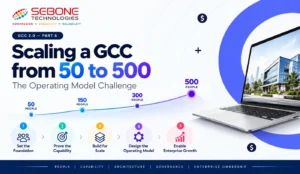
In Part 6, we saw that scaling a GCC from 50 to 500 is an operating-model challenge. Once a GCC reaches that scale, an even harder question follows: how do we know it is creating value?
For years, the business case for a Global Capability Centre was simple: lower operating cost, access to talent, improved efficiency and scale. The math was straightforward:
Cost at headquarters → Cost at GCC → Savings created
For GCC 1.0, that was often enough. But the GCC has changed. Today’s GCCs build products, own platforms, develop intellectual property, drive AI adoption and contribute directly to global business outcomes. That creates a measurement problem:
The more valuable the GCC becomes, the less accurately traditional ROI metrics describe its value.
So the GCC 2.0 question is no longer how much we save. It is:
What enterprise value is the GCC creating?
The problem with cost-only measurement
Cost is measurable. Value is more complex. That is why organizations default to cost per FTE, total headcount, utilization, hiring cost, delivery cost and annual savings. These metrics are useful, but they measure efficiency, not strategic impact.
Consider two GCCs:
| GCC A | Saves $30 million a year through lower labor costs. |
| GCC B | Saves $15 million, and also builds a global AI platform, shortens software release cycles, automates thousands of hours of work, owns critical engineering capabilities and launches new digital products. |
Which one creates more enterprise value? Clearly GCC B. Yet a traditional scorecard could rank GCC A higher. To fix that, we need a wider view of value.
The five layers of GCC value
A GCC 2.0 ROI framework should measure value across five layers, each building on the one before:
| Layer | Key question | What to measure |
|---|---|---|
| 1. Cost Efficiency | How efficiently do we deliver? | Cost savings, productivity, utilization, operating leverage |
| 2. Capability | What strategic capabilities have we built? | Critical skills, centers of excellence, technology and domain expertise, leadership depth |
| 3. Innovation | What exists now that did not before? | New products and platforms, patents, AI use cases, automation |
| 4. Business Impact | Which outcomes have improved? | Revenue enabled, customer experience, time-to-market, risk reduction |
| 5. Strategic Enterprise Value | What does the enterprise now own because of the GCC? | Global ownership, IP, enterprise platforms, critical technology capabilities, resilience |
Layer 1 is the traditional foundation. Layers 2 to 5 are where GCC 2.0 value shows up. Together they change the logic of the whole model, from a cost center to a value center.
From cost center to value center
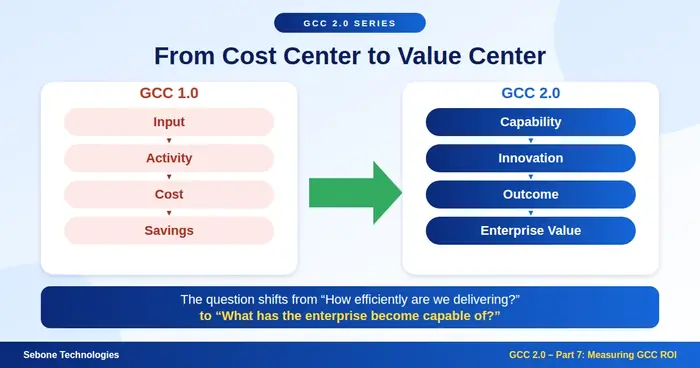
The shift can be captured in two simple chains:
- GCC 1.0: Input → Activity → Cost → Savings
- GCC 2.0: Capability → Innovation → Outcome → Enterprise Value
The first model asks, “How efficiently are we delivering?” The second asks:
What has the enterprise become capable of because of the GCC?
That is the strategic ROI question. Answering it starts with how we measure productivity.
Measure productivity differently
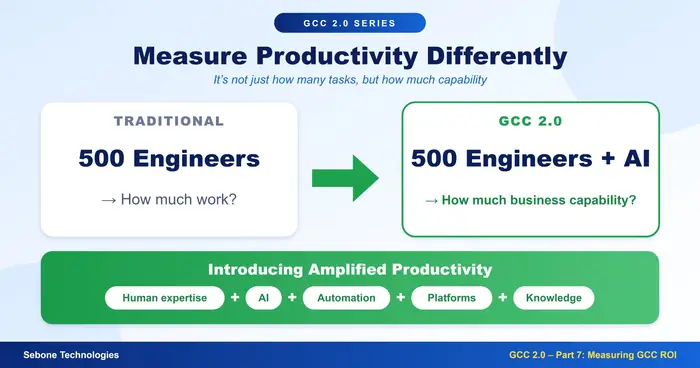
AI makes traditional productivity metrics even less reliable. Take a GCC with 500 engineers. The traditional question is how much work 500 engineers can deliver. The GCC 2.0 question is how much business capability 500 engineers, AI, automation and platforms can deliver.
This is Amplified Productivity:
Human expertise + AI assistance + automation + reusable platforms + institutional knowledge
It can be measured through shorter development cycles, automated testing, reduced manual effort, faster analysis and incident resolution, less documentation effort and higher release frequency. The goal is not to count how many tasks people complete. It is to measure how much capacity the operating model creates.
Measure capability creation
Some of a GCC’s most valuable outputs don’t appear on the income statement right away. Imagine a GCC builds a world-class AI engineering team. At first, it may add cost. Over time, that capability can support new products, AI transformation, automation, data platforms, customer solutions and new revenue. The initial investment becomes an asset.
That is why GCC ROI should track capability created, maturity, utilization, scalability and uniqueness. The GCC isn’t simply employing people. It is building an enterprise capability portfolio. Capability isn’t the only thing scorecards overlook, though.
Four measures most scorecards miss
Intellectual property. Proprietary software, algorithms, AI models, data platforms, engineering frameworks and patents carry long-term value that can far exceed annual savings. IP creation belongs on the GCC scorecard.
Revenue enabled. A GCC may not own a P&L, but it can still enable revenue by building digital products, improving onboarding, reducing transaction failures or speeding up launches. Revenue enabled is revenue that would not have been possible, or would have been delayed or reduced, without the capability the GCC created.
Speed. Cutting product launch from 12 months to 6, AI deployment from 9 months to 3, or incident resolution from hours to minutes creates strategic speed and resilience. Track time-to-market, time-to-decision, time-to-deployment, time-to-resolution and time-to-capability. Speed isn’t just an operational metric. It creates economic value.
Risk reduction. Stronger cybersecurity, modernized legacy systems, better compliance and data governance create value that is hard to price but real. A capability that prevents one major incident can outweigh years of cost savings. GCC 2.0 should consider risk-adjusted enterprise value, not just direct savings.
Build a GCC value scorecard
Bring these measures together in one scorecard with five dimensions:
| Dimension | Example metrics |
|---|---|
| Efficiency | Cost savings, productivity, utilization |
| Capability | Critical skills, CoEs, capability maturity |
| Innovation | AI use cases, automation, patents, new products |
| Business Impact | Revenue enabled, time-to-market, customer outcomes |
| Strategic Value | IP, platform ownership, risk reduction, global ownership |
The weighting should change as the GCC matures:
| Stage | Key question | Scorecard emphasis |
|---|---|---|
| 1. Efficiency | How much can we save? | Efficiency carries the most weight |
| 2. Productivity | How much more can we deliver? | Productivity gains sit alongside efficiency |
| 3. Capability | What can we build and own? | Capability and business impact grow in weight |
| 4. Enterprise Value | What business outcomes can we influence? | Enterprise value dominates |
The mistake is staying at Stage 1. A GCC that still justifies itself through labor arbitrage after building strategic capabilities is undervaluing its own asset. And a 500-person strategic GCC should never be measured with the framework built for a 50-person delivery center.
Make GCC ROI a shared conversation
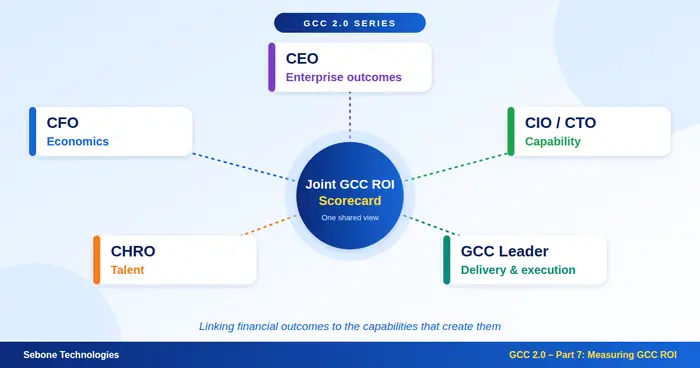
A better scorecard also needs the right people reading it. GCC ROI should be assessed jointly by the CEO, CFO, CIO/CTO, CHRO and GCC leader, because each sees value differently:
- CFO: economics
- CIO/CTO: capability
- CHRO: talent
- CEO: enterprise outcomes
The scorecard should connect these perspectives. The goal is not to drop financial measurement. It is to link financial outcomes to the capabilities that create them.
The new GCC ROI equation
A more complete model looks like this:
GCC Value = Efficiency + Capability + Innovation + Business Impact + Strategic Enterprise Value
And, increasingly:
GCC ROI = Enterprise Value Created ÷ Total GCC Investment
The challenge is defining enterprise value correctly. That means going beyond Salary × Headcount to Capabilities + IP + Productivity + Revenue Enablement + Speed + Risk Reduction + Innovation. That is where the true economics of GCC 2.0 emerge.
Seven questions every CEO should ask
Before judging GCC performance, leadership should ask:
- What capabilities did the GCC create this year?
- What business outcomes did those capabilities influence?
- How much productivity did AI and automation create?
- What products, platforms or IP does the GCC now own?
- How much revenue did the GCC enable, and what risks did it reduce?
- How much faster can the enterprise now innovate?
- What strategic capability would be missing if the GCC did not exist?
The last question may be the most powerful, because it measures strategic indispensability.
From savings to enterprise value
The first generation of GCCs proved that global talent can deliver work efficiently. The second must prove that global capability can create enterprise advantage. That needs a different measurement philosophy. Not just “How much did we save?” but:
- What did we build?
- What did we accelerate?
- What did we enable?
- What did we protect?
- What did we transform?
And ultimately:
What is the enterprise worth more because this GCC exists?
That is the real ROI question for GCC 2.0. It also leads to the next one: if GCCs are capability engines, where in the world is the best place to build them?
KEY TAKEAWAYS
- Look beyond cost savings. Efficiency is the foundation, not the full story.
- Measure enterprise value. Use all five layers: efficiency, capability, innovation, business impact and strategic value.
- Track capability creation. Capabilities, IP, speed and risk reduction are real assets.
- Build a future-ready GCC. Make ROI a shared conversation across the leadership team.
COMING NEXT – PART 8
Why India? The Structural Advantage Behind GCC 2.0
India’s GCC story is usually explained by talent and cost. That explanation is increasingly incomplete.
Part 8 examines the deeper structural advantages behind India’s GCC ecosystem: talent density, technology capability, engineering depth, digital infrastructure, ecosystem maturity and the ability to build globally relevant capabilities at scale.
The question is no longer “Why India for lower-cost delivery?” It is “Why India for building the capabilities that will define the global enterprise of the future?”