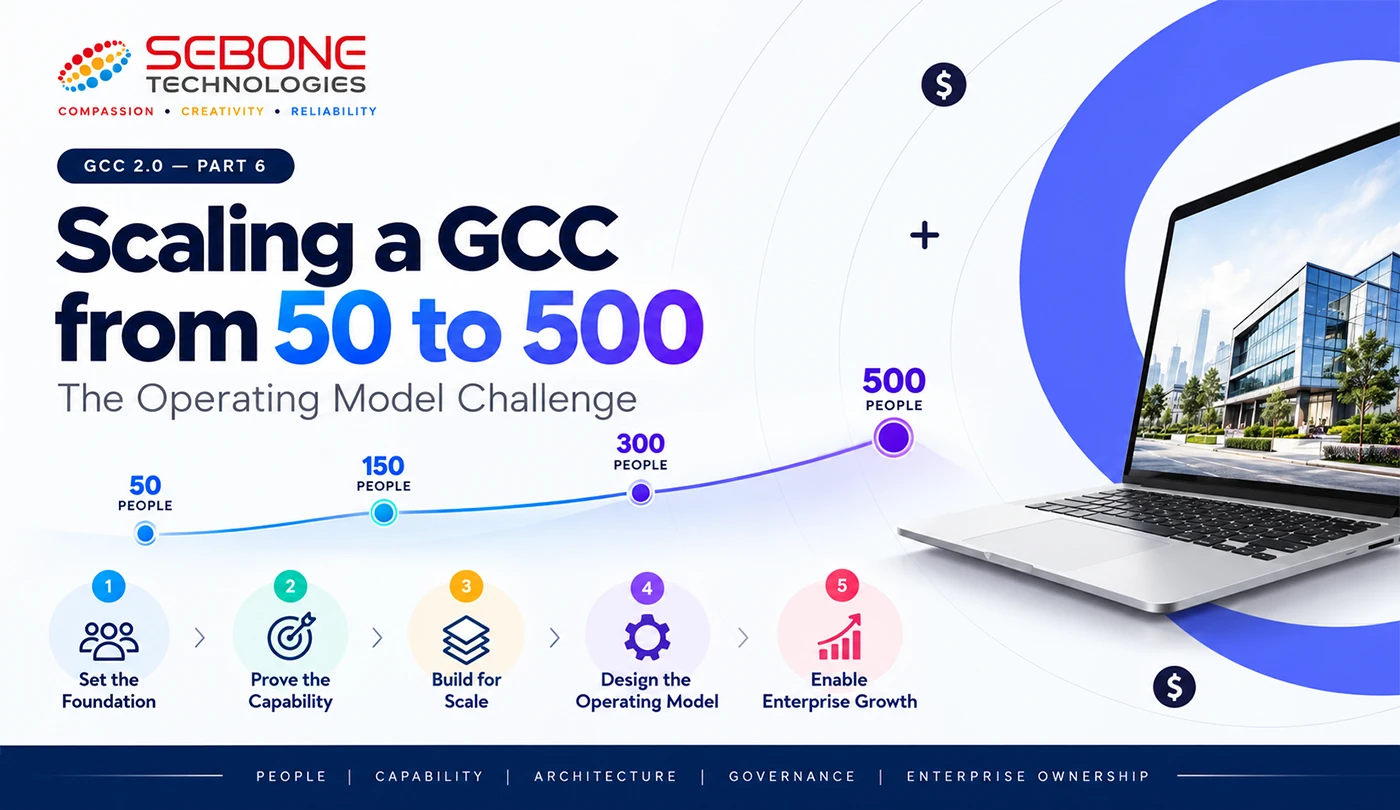
Scaling a GCC from 50 to 500 employees sounds like a tenfold hiring exercise. It isn’t. It is a tenfold increase in complexity.
At 50 people, a leader can solve problems through relationships and quick conversations. At 500, that stops working. More people create more teams, more teams create more dependencies, and more dependencies create more governance. Without a deliberate operating model, the GCC can slow down just when it was supposed to become more capable.
Scaling a GCC is not primarily a headcount challenge. It is an operating-model challenge.
So the GCC 2.0 question is not “How do we grow from 50 to 500?” It is:
“How do we increase capability tenfold without increasing complexity tenfold?”
Why a GCC Operating Model Must Change as It Scales
A 50-person GCC can run informally. The leader knows almost everyone, decisions happen in a single meeting, and escalations happen over a phone call.
At 500, the organization needs:
- Clear accountability and defined decision rights
- Capability ownership and standardized processes
- Leadership layers and performance management
- Technology platforms and workforce planning
The challenge is to add structure without adding bureaucracy. The right structure depends on the stage, so let’s walk through the journey.
Stage 1 (0–50): Prove the Capability
The first stage is about proving the model, not scaling it. A weak model multiplied tenfold becomes a much bigger problem. By 50 people, leadership should have clear answers on:
- Strategic purpose: why does the GCC exist?
- Initial capabilities: what does it uniquely own?
- Business alignment: which global outcomes does it support?
- Leadership and delivery model: who decides, and how does work enter and leave?
- Success metrics: how will value be measured?
Prove, learn and refine first. Then scale, replicate and expand.
Stage 2 (50–150): Build Around Capabilities
Once the model works, the GCC needs structure. Instead of organizing only around projects, build durable capability units such as:
- AI & Data
- Digital Engineering
- Cloud & Platforms
- Cybersecurity
- Enterprise Applications
- Product & Experience
The exact mix will vary by enterprise. The principle matters more:
Build around capabilities the enterprise wants to retain and deepen.
This creates lasting institutional knowledge instead of temporary project teams that are assembled and dissolved again and again.
Stage 3 (150–300): Design the Operating Architecture
At this size, the GCC may serve several business units and geographies, with dozens of programs running at once. Coordination becomes the main challenge. A strong operating architecture answers five questions:
- Ownership: who owns the capability?
- Accountability: who owns the outcome?
- Decision rights: who can make which decisions?
- Interfaces: how does the GCC work with headquarters and business units?
- Governance: how are priorities, risks and investments managed?
Without clear answers, organizations compensate with meetings, and meetings become the unofficial operating system. That rarely scales.
Stage 4 (300–500): Move from Delivery to Ownership
This is the most important transition. At 500 people, the GCC should do more than execute work assigned by headquarters. It should increasingly own platforms, products, technology domains, data and AI capabilities, engineering standards, intellectual property and transformation programs.
The difference is subtle but significant:
- Delivery model: “Tell us what to build.”
- Ownership model: “Here is the business problem. We will determine how to solve it.”
The ownership model creates far more strategic value. It also needs the right leadership and governance.
The Five Stages at a Glance
Here is how the focus and the leadership question change at each stage:
| Stage | Focus | Leadership question |
|---|---|---|
| 0–50 | Establish | Why does the GCC exist? |
| 50–150 | Build | What capabilities should we develop? |
| 150–300 | Structure | How should the organization operate? |
| 300–500 | Scale | How do we increase ownership and productivity? |
| 500+ | Transform | What strategic capabilities should the GCC lead globally? |
Scale With Leverage, Not Layers
A common reaction to growth is to add management layers: a few heads at 150, more directors at 300, several layers at 500. Eventually managers spend more time coordinating other managers, and the organization slows down.
GCC 2.0 favors high-leverage leadership instead:
- More ownership per leader
- More autonomy per team
- Fewer unnecessary handoffs
- Faster decisions
Governance is still necessary, but it should enable speed. Separate decisions into three levels:
- Strategic: investment, capability ownership, major priorities and risk
- Operational: delivery, staffing, execution and prioritization
- Team: technical implementation, workflow and day-to-day work
The closer a decision is to the work, the faster it should be made. The principle is simple:
Centralize standards. Decentralize execution.
The best scalable organizations don’t have the most managers. They have the clearest accountability.

Design for AI-Enabled Scale
The biggest difference between scaling a GCC today and five years ago is AI. Traditional scaling assumes more demand means more people. GCC 2.0 asks instead: how can better processes, AI, automation and targeted talent meet that demand?
Take a software engineering organization. Rather than growing from 100 to 200 to 400 engineers, it can combine senior expertise with AI coding assistants, automated testing, DevOps automation, reusable platforms and intelligent knowledge systems. The result is significant capacity growth without proportional headcount growth.
Human capability × AI capability = amplified enterprise capacity
In this model, AI is part of the scaling architecture, not just a productivity tool. It only delivers when work is redesigned around it.
Build a Global-Local Partnership
A GCC is neither fully independent nor fully controlled by headquarters, and the relationship should evolve.
- Headquarters provides: enterprise strategy, business priorities, global standards, the risk framework and capital allocation.
- The GCC provides: capability expertise, technology execution, innovation, product and platform ownership, AI transformation and domain expertise.
This turns a reporting relationship into a partnership. The GCC becomes a global capability node, not an offshore department.
Measure Scale Through Outcomes
As the GCC grows, its scorecard must grow with it. At 50 people, hiring, attrition, ramp-up and delivery are enough. At 500, they are not. The scorecard should also ask:
- Capability: what strategic capabilities have been created?
- Ownership: which products, platforms or domains does the GCC own?
- Innovation: what new solutions have been built?
- Productivity: how much capacity have AI and automation generated?
- Business impact: which outcomes have improved?
- Talent: are critical skills being built internally?
- Enterprise value: what measurable value is the GCC creating?
This keeps growth from becoming an end in itself.
The CEO Checklist Before Scaling
Before approving a major expansion, leadership should ask:
- What capabilities will the next 100 hires create?
- What work should be automated before adding people?
- Where can AI amplify existing teams?
- Which decisions should move closer to the GCC?
- What products, platforms or IP should the GCC own?
- Is management growing faster than capability?
- Can the current operating model handle two to three times the complexity?
If these questions can’t be answered, the organization may be scaling headcount before capability.
From 50 to 500 and Beyond
Scale is not one lever. It is Talent + Technology + Operating Model + Governance + AI, and they only work when they evolve together. More talent without a new operating model adds complexity. More governance without autonomy slows decisions. AI without redesigned work adds little.
The first generation of GCCs proved that global talent hubs can deliver quality work at scale. The next generation must prove they can scale strategic capability. That means a shift:
- From teams to capabilities
- From projects to products
- From delivery to ownership
- From headcount to capacity
- From hierarchy to accountability
- From manual work to Human + AI
The goal is not 500 people. It is 500 people delivering the capability of an organization built for far greater enterprise impact. The GCC of the future will be defined by how much of the enterprise’s future capability it can create, own and accelerate. That is the operating-model challenge of GCC 2.0.
Coming Next — Part 7
Measuring GCC ROI: From Cost Savings to Enterprise Value
Once a GCC grows from 50 to 500, one question becomes unavoidable: how do we know it is creating value?
Part 7 looks beyond cost savings, headcount and utilization. It builds an ROI framework around capability, innovation, productivity and enterprise outcomes, and shows how to move from a cost center to a value center.