
GCC talent strategy used to be simple: define roles, hire, build teams, scale. That worked when GCCs existed to expand delivery capacity. Today they’re expected to drive innovation, own IP, accelerate AI adoption, and move the P&L.
The question has changed. Not “how many people do we need,” but *what capabilities do we need, and what’s the fastest way to create them.*
The answer: Build, Buy, or Augment. The best GCCs don’t pick one — they know which to apply, when.
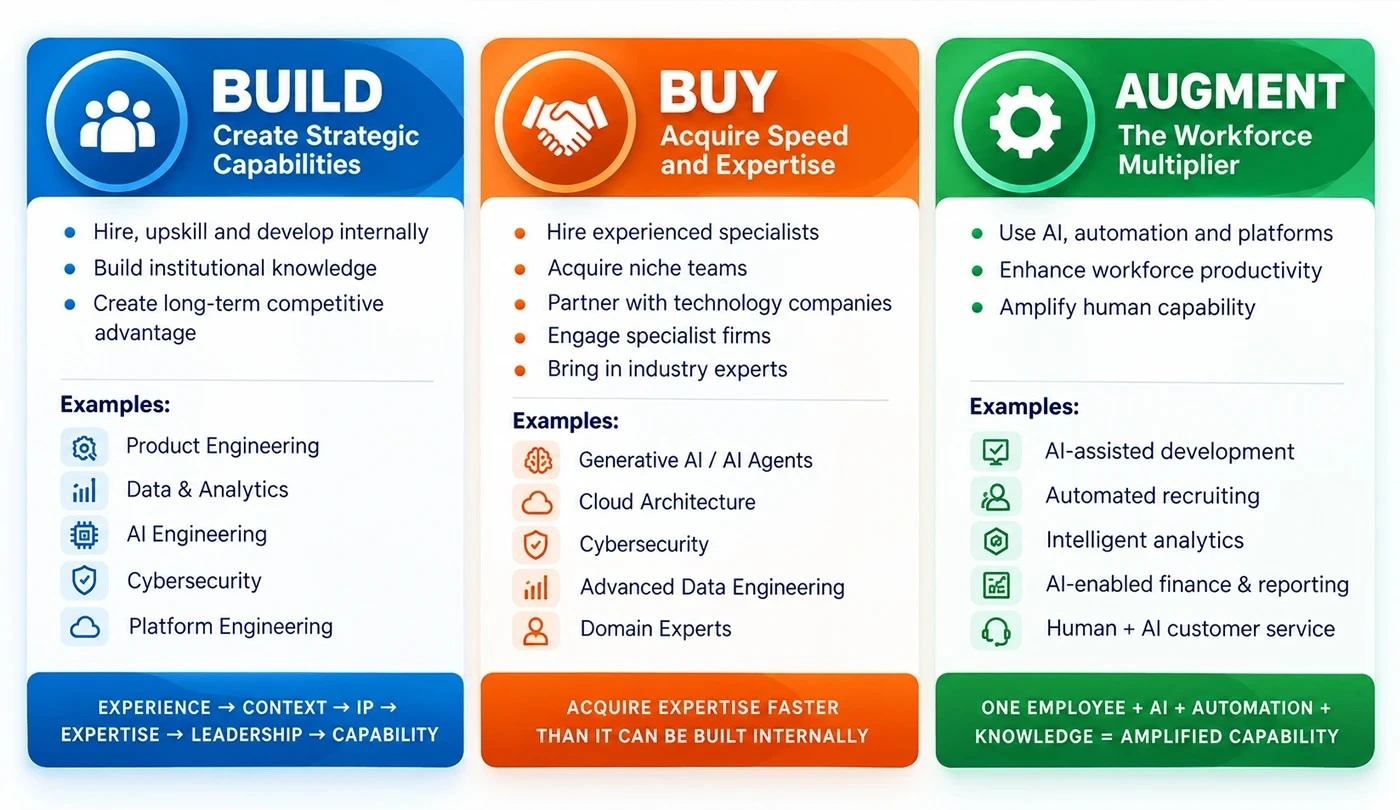
1. Build — for what differentiates
Some capabilities are too strategic to outsource: product engineering, enterprise architecture, data & analytics, AI engineering, cybersecurity, platform engineering, product management, digital transformation. Building compounds — experience becomes context, context becomes IP, IP becomes an edge competitors can’t copy. The cost is time: deep expertise takes years to grow.
2. Buy — for what accelerates
In fast-moving areas — GenAI, AI agents, cloud architecture, cybersecurity, advanced data engineering — speed beats ownership. Buy means hiring specialists, acquiring niche teams, partnering, or bringing in outside experts. The logic is simple: acquire the capability faster than you could build it. If the business needs it in six months, a three-year build plan isn’t an option. In GCC 2.0, speed is the advantage.
3. Augment — for what scales
AI is rewriting the productivity equation. One employee used to equal one unit of output; now it’s employee + AI + automation + enterprise knowledge = amplified output. Engineers ship code faster with AI pair-programming. Analysts turn research around quicker. Recruiters automate sourcing. Finance teams forecast with AI. Support teams blend human judgment with AI-assisted workflows. AI isn’t a technology line item anymore — it’s a workforce multiplier.
From workforce planning to capability planning
Old model: demand → roles → headcount → hiring.
New model: business demand → capability → work design → human + AI → capacity.
Before deciding who to hire, decide what the work actually needs: judgment, domain expertise, creativity, relationships, decisions — versus what can be automated or AI-assisted.
Related Article- The AI-Native GCC
The framework, in five questions
1. Is it strategically differentiating? → Build.
2. Does speed matter more than ownership? → Buy.
3. Is the capability widely available in the market? → Buy.
4. Can technology meaningfully lift productivity? → Augment.
5. Will it matter more over time? → Build for the long term.
The real answer is all three at once
Not Build vs. Buy vs. Augment — Build + Buy + Augment. Standing up an AI engineering function might mean: buy the leaders and architects who’ve done it before, build an internal engineering community with deep domain knowledge, and augment both with AI coding assistants and agentic workflows. Combined, you get speed, scale, institutional knowledge, and productivity — together.
Why annual hiring plans are falling behind
Technology cycles now move faster than workforce planning cycles. The right question isn’t “how many people next year” — it’s “what capabilities will we need, and what mix of people, technology, and partners delivers them.”
Capability velocity is the new scale
GCCs used to compete on headcount. They’ll now compete on how fast they can move through: identify → acquire → build → augment → scale → deliver value. Speed of capability creation is starting to matter more than size of workforce.
The GCC 2.0 talent strategy, in short
Build what differentiates. Buy what accelerates. Augment what scales. Combine all three. The goal was never headcount — it’s enterprise capability and business impact.
Before approving the next 100 hires, ask:
Can we build this internally? Can we buy it faster? Can AI amplify the talent we already have? Can automation remove part of the work? Could a smaller, sharper team deliver more?
The future GCC talent isn’t people or technology. It’s the right architecture of people, expertise, AI, automation, platforms, and partners. The GCCs that master it won’t just have more talent — they’ll have more capability, more agility, and more impact.
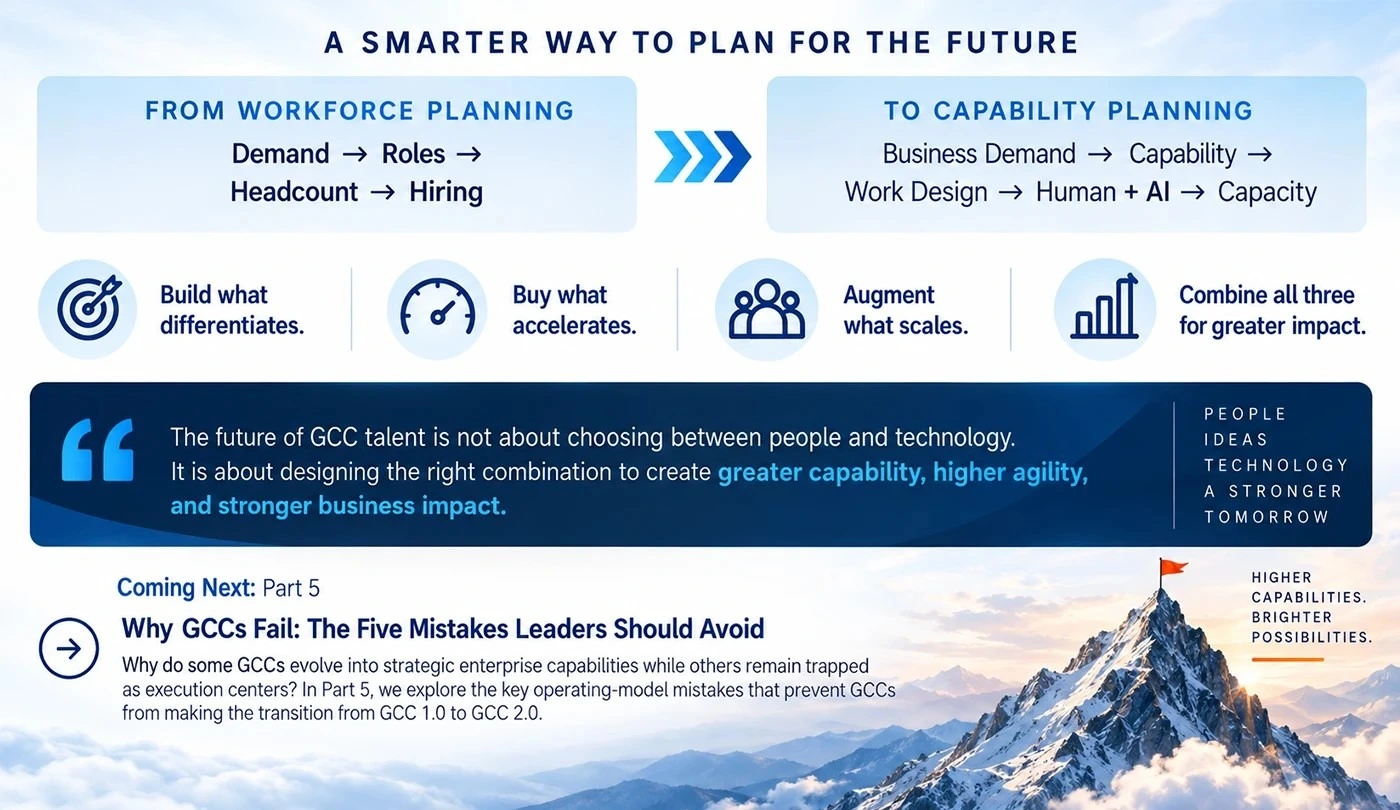
Coming Next — Part 5: Why GCCs Fail: The Five Mistakes Leaders Should Avoid