

As an AI-enabled technology and talent leader, Sebone Technologies helps global enterprises build secure offshore teams while preparing young Indian professionals for the AI-first economy. Building an effective offshore team involves more than finding the right developers. Businesses also need to define their requirements, choose the right engagement model, assess potential teams, and establish a practical way of working together
A structured approach can make offshore hiring easier to manage and help businesses build a team that fits their technical and operational requirements.
Key Takeaways
- Define your project scope, technology requirements, and team structure before starting the search.
- Choose between staff augmentation, a dedicated team, or another engagement model based on the work involved.
- Evaluate technical skills, communication, experience, and working practices before making a decision.
- Establish clear processes for onboarding, collaboration, security, and project management.
- Consider local compliance and employment requirements when hiring talent in another country.
How to Hire an Offshore Development Team
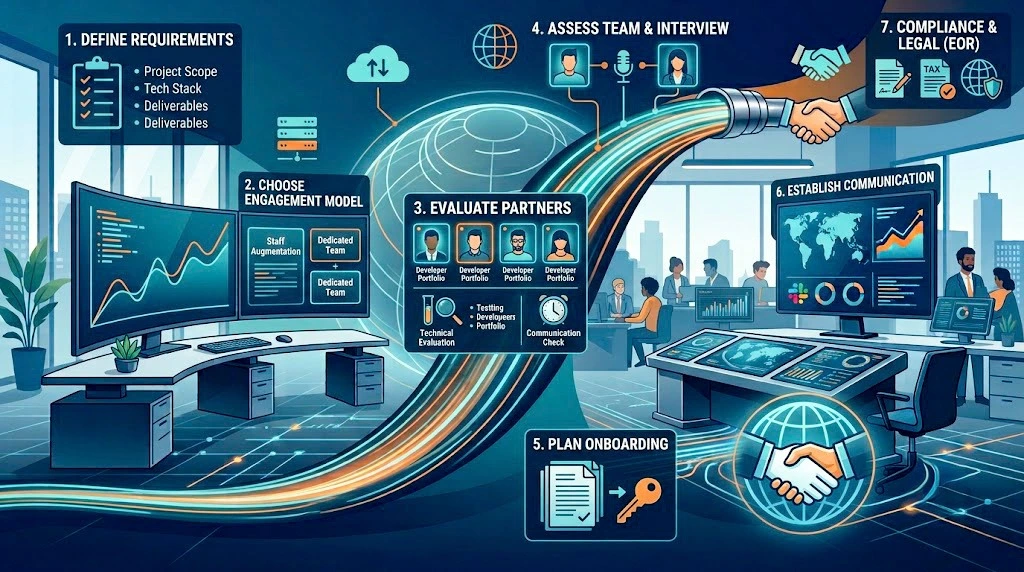
Hiring an offshore development team involves more than finding developers with the right technical skills. The following steps can help you assess your requirements and build a working structure that fits your project.
1. Define Your Project Requirements
Start by establishing what you actually need from the offshore team. This includes the project scope, expected deliverables, technology requirements, team size, and level of expertise required.
For example, a business may need additional developers for an existing product, a team to build a new application, or specialists for areas such as cloud infrastructure, DevOps, data science, or AI.
It is also important to decide how much responsibility the offshore team will have. This helps determine whether you need individual specialists to work with your internal team or a more dedicated team structure.
2. Choose the Right Engagement Model
Offshore development does not follow a single hiring model. The right approach depends on how the business wants to work with the external team.
| Staff augmentation | When you already have an internal development team but need additional technical expertise or capacity | External professionals work alongside your existing employees while your business retains control over project priorities and management. |
| Dedicated team | When you need a group of professionals for an ongoing development requirement | A dedicated group works on your development needs through a structured team setup, without requiring you to build the entire team internally. |
The important consideration is not simply the size of the team, but how responsibilities, management, and delivery will be handled.
3. Evaluate the Offshore Development Partner
Once you know what you need, assess potential technology partners carefully.
Look at their experience with similar technical requirements, the type of professionals they can provide, and how they approach candidate selection. Ask how technical capabilities are evaluated and whether you can review the experience of the professionals who may work on your project.
Communication should also be part of the evaluation. Offshore teams may work across different locations and time zones, so businesses should establish expectations around working hours, meetings, documentation, and communication channels from the beginning.
4. Assess the Team Before Hiring
A CV or portfolio alone does not provide the complete picture. When you hire offshore developers, assess their technical experience, problem-solving approach, and ability to work within your project environment.
Depending on the role, this may involve technical discussions, practical assessments, portfolio reviews, or interviews with the professionals who will work on the project.
If you are working through an offshore development partner, also understand how candidates are screened and selected. This can help ensure the proposed team matches the skills and experience your project requires.
5. Plan the Onboarding Process
Once the team is selected, onboarding should begin with clear documentation and access to the tools required for the project.
Share relevant technical documentation, project requirements, coding standards, workflows, and access permissions. The offshore team should also understand who is responsible for decisions, approvals, reviews, and day-to-day communication.
Starting with clearly defined tasks can help new team members understand the existing environment before taking ownership of larger components.
6. Establish Clear Communication
Working offshore does not have to mean working in isolation. The team should have a defined communication structure that covers project updates, technical discussions, issue resolution, and reviews.
Tools such as project management platforms, version control systems, and communication applications can support day-to-day collaboration. However, the tools themselves are less important than having clear processes around how they are used.
Businesses should also agree on overlapping working hours where necessary, particularly when teams operate across different time zones.
7. Consider Compliance and Employment Requirements
Hiring professionals in another country can involve employment, payroll, tax, and regulatory considerations. Businesses should understand these requirements before establishing an offshore workforce.
An Employer of Record (EOR) model can be relevant when a company wants to hire employees in another country without establishing its own local entity. An EOR can handle areas such as local employment administration, payroll, and statutory requirements, depending on the arrangement.
This allows the business to focus on managing the technical work while the relevant employment responsibilities are handled through the appropriate structure.
How Sebone Technologies Supports Offshore Development
Sebone Technologies helps businesses access technology professionals and development teams through flexible engagement models.
Its Smart Team offering provides dedicated technology professionals or remote development teams that can work with a client’s existing requirements. Depending on the engagement, businesses can access comprehensive offshore development services across software engineering, cloud and DevOps, data science and AI, product engineering, and related technology functions.
The company also provides Employer of Record services in India, supporting businesses that need to engage talent in India while addressing local employment and compliance requirements.
For businesses considering offshore development, the focus should be on finding a model that matches the project’s technical needs, team structure, and level of control. A clear scope, suitable engagement model, structured evaluation process, and defined working practices can provide a practical foundation for building an offshore development team.
FAQ’s
When should a business consider hiring an offshore development team?
A business can consider offshore development when it needs specialised technical expertise, additional development capacity, support for a new project, or a flexible way to expand its technology team.
How long does it take to build an offshore development team?
The timeline depends on the number of professionals required, the complexity of the roles, candidate availability, and the selection process. Clearly defined requirements can help businesses identify suitable candidates more efficiently.
What engagement models are available for offshore development?
Common models include staff augmentation, dedicated development teams, and project-based outsourcing.
Can an offshore development team work with an existing in-house team?
Yes. Offshore developers can collaborate with in-house teams through shared project management tools, version control systems, technical documentation, code reviews, and regular planning meetings.
What factors determine the right size of an offshore development team?
The appropriate team size depends on project scope, delivery timelines, technical complexity, workload, and the skills required.
Is offshore development suitable for startups and small businesses?
Yes, offshore development can help startups and small businesses access specialised technical talent without recruiting every role internally.
Can I hire offshore developers for a short-term project?
Yes, businesses can hire offshore developers for short-term projects, product launches, specific technical tasks, or temporary skill requirements.
How do I choose the right country for offshore software development?
Choose a country based on technical talent availability, overall costs, time zone compatibility, English communication skills, data protection requirements, and the local business environment.
Is it better to hire offshore developers directly or through a company?
Hiring directly gives businesses more control over candidate selection and employment arrangements, while working through a development company can simplify talent sourcing, team formation, and ongoing coordination.
How do I choose the right company for offshore software development?
To choose the right company for offshore software development, evaluate its technical expertise, experience with similar projects, developer screening process, communication practices, security standards, pricing, and engagement models.